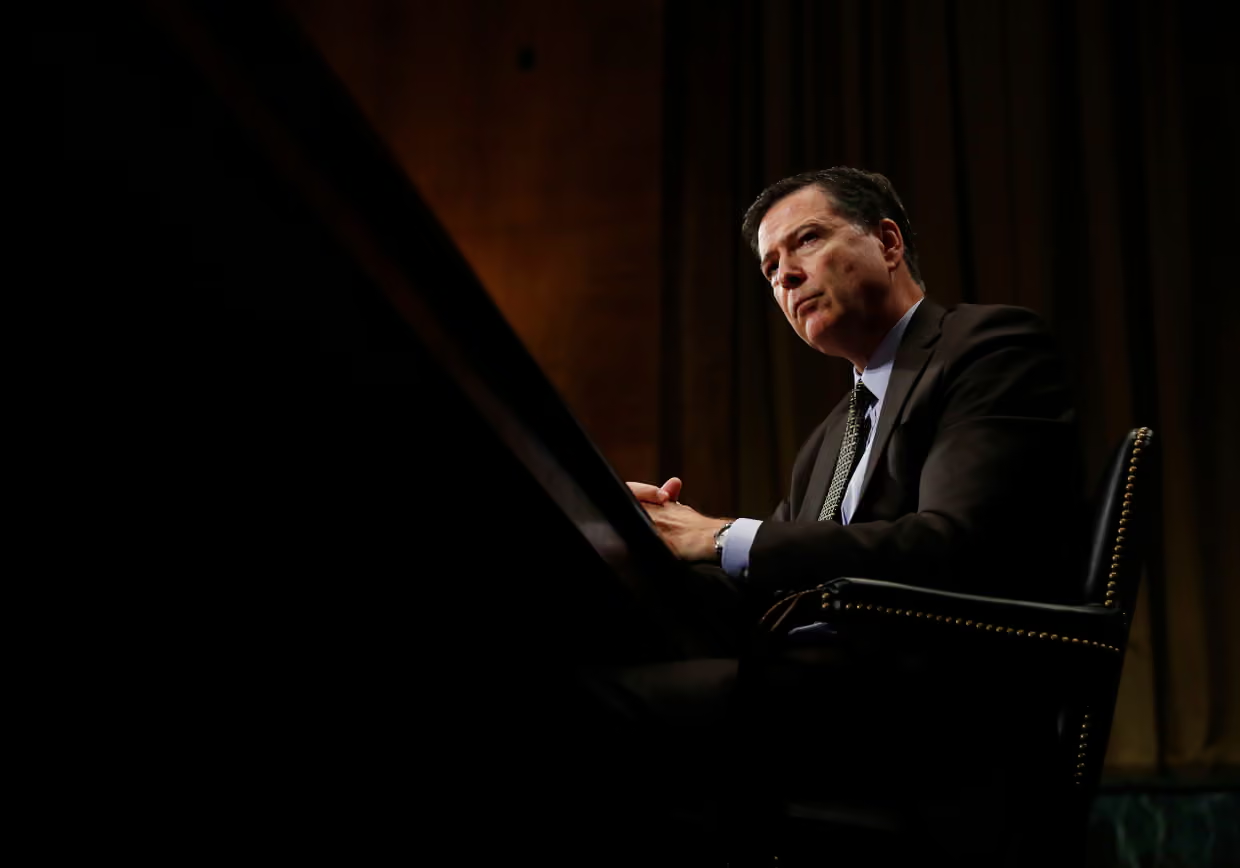

James Comey, the former FBI director who has long been one of Donald Trump’s most prominent adversaries, was indicted on Thursday on two criminal counts: making a false statement to Congress and obstruction of a congressional proceeding. The charges, unveiled in federal district court in Alexandria, Virginia, mark a dramatic escalation in Trump’s push to prosecute political opponents and settle old scores.
The Charges
The indictment accuses Comey of lying under oath during testimony before lawmakers in September 2020 about the FBI’s handling of sensitive investigations. Specifically, prosecutors allege that Comey falsely claimed he had never authorized anyone at the FBI to disclose information to the press about either the Trump or Hillary Clinton investigations.
The filing also cites an alleged attempt by Comey to obstruct a congressional proceeding by withholding details and misleading lawmakers about the origins and conduct of the bureau’s Russia probe, which examined ties between the Trump campaign and Moscow during the 2016 election.
The document itself was sparse—just two pages—but it pointed to long-standing Republican accusations that Comey misled the public and Congress during one of the most politically charged periods in recent U.S. history.
Attorney General’s Statement
Attorney General Pam Bondi, who was appointed by Trump last year after a contentious Senate confirmation, framed the indictment as a victory for accountability.
“No one is above the law,” Bondi said in a statement. “Today’s indictment reflects this Department of Justice’s commitment to holding those who abuse positions of power accountable for misleading the American people.”
Bondi’s remarks echo the Trump administration’s broader stance: that former officials who, in their view, worked to undermine the former president should face legal consequences.
Trump’s Reaction
Trump wasted no time in celebrating the indictment, posting repeatedly on his social media platform, Truth Social.
“James Comey LIED to Congress and to the American People. He obstructed justice. This is long overdue. Total vindication!” Trump wrote, calling the former FBI director “one of the worst in history.”
For Trump, the charges are deeply personal. His firing of Comey in May 2017 sparked the appointment of Special Counsel Robert Mueller and the Russia investigation, which Trump has long denounced as a “witch hunt.” Since then, the former president has consistently accused Comey of corruption and betrayal, making him one of his most frequent political punching bags.
Comey’s Response
Comey, 64, maintained his innocence and vowed to fight the charges in court. Speaking briefly outside his Virginia home, he said:
“I’m innocent. Let’s have a trial. I look forward to the chance to prove that these charges are baseless and politically motivated.”
In a written statement, Comey described the indictment as “an abuse of prosecutorial power” designed to silence critics of the president. He argued that the case has little to do with justice and everything to do with Trump’s determination to punish perceived enemies.
A Feud Years in the Making
The indictment is the latest twist in a long-running feud between Trump and Comey.
- 2016 Election: As FBI director, Comey came under fire for publicly announcing the reopening of the Hillary Clinton email investigation just days before the election—a move some Democrats believe cost Clinton the presidency.
- 2017 Firing: Trump dismissed Comey while he was overseeing the FBI’s Russia investigation, a decision that triggered widespread controversy and the appointment of Mueller as special counsel.
- Comey’s Memoirs: In the years after his firing, Comey published books and gave interviews highly critical of Trump, describing him as “morally unfit” for office.
- Political Retaliation Claims: Trump, in turn, has repeatedly accused Comey of being part of a “deep state conspiracy” and vowed to hold him accountable if given the chance.
Thursday’s indictment suggests Trump is now delivering on that long-promised retribution.
Broader Political Context
The charges come amid a wave of legal actions against former officials, critics, and perceived opponents of the Trump administration. Analysts say the indictment of Comey may be viewed not just as a legal case but as a political weapon.
“This is less about what Comey said to Congress in 2020 and more about Trump’s determination to rewrite the history of the Russia investigation,” said one legal scholar. “The Justice Department is now being used to settle scores.”
Civil liberties advocates warned that the indictment could chill future testimony from government officials who fear political reprisals. They also noted that prosecuting a former FBI director—a position traditionally shielded from political interference—represents an extraordinary moment in American governance.
What Comes Next
Comey is expected to make his first court appearance in Alexandria next week. If convicted, he faces up to five years in prison for making false statements and up to 20 years for obstruction, though actual sentences for first-time offenders are often lower.
The case will likely hinge on how prosecutors interpret Comey’s 2020 testimony and whether jurors believe he deliberately misled Congress or simply made inaccurate statements under complex questioning.
Meanwhile, Trump is expected to continue leveraging the case as proof that his long-standing complaints about the FBI and “deep state” interference were justified.
James Comey’s indictment marks a stunning turn in the ongoing saga between the former FBI director and Donald Trump. What began as a firing that shook Washington has now evolved into criminal charges, with both men once again at the center of a storm that combines law, politics, and personal vendetta.
For Comey, the trial will be a chance to defend his legacy and credibility. For Trump, it is already a political victory—a moment he can frame as the triumph of his relentless campaign against those he views as enemies.
But beyond the personal feud, the case raises profound questions about the independence of the Justice Department, the weaponization of prosecutions, and the fragile boundaries between law and politics in modern America.