
How the U.S. Decides Its Tariff Rates: Breaking Down the Mystery Behind Trade Deficits and Imports”

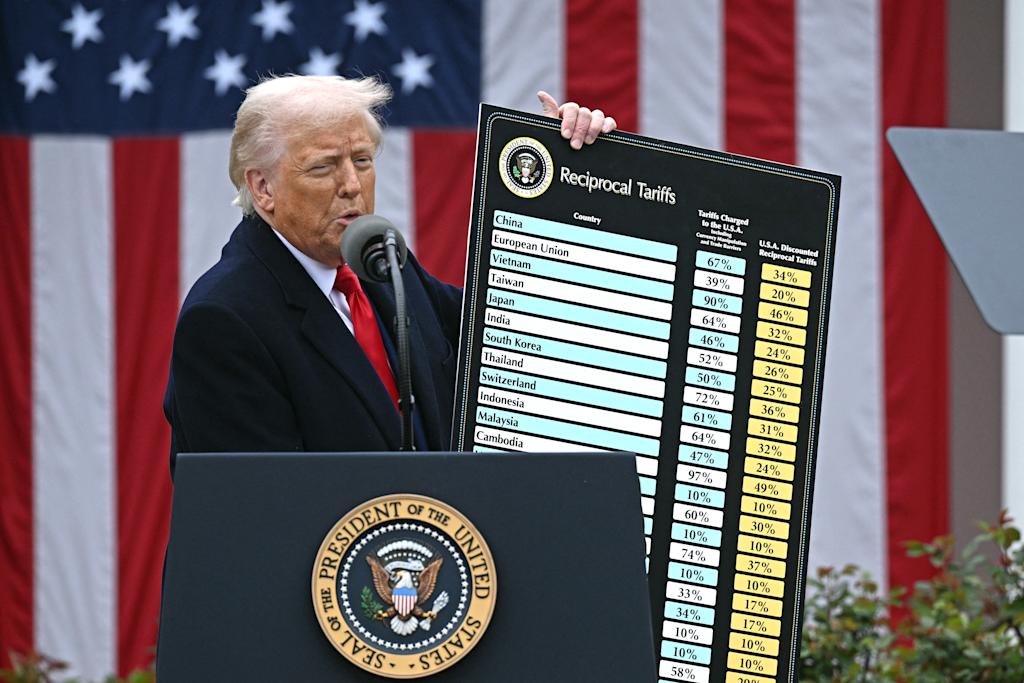
The U.S. has just revealed its new tariff rates for different countries, leaving many market analysts scrambling to figure out how these figures were determined. It didn’t take long for some experts to speculate that the U.S. might have used a simple formula — dividing the trade deficit by the amount of goods imported from each country. But is this really how the U.S. calculated its tariff rates? And what does it mean for global trade? Let’s break it down in a way that’s easy to understand and see how the White House came up with these numbers.
How Did the U.S. Calculate Tariffs? A Simple Formula?
When the U.S. announced its new tariff structure, observers quickly noticed a pattern. The tariff rates seemed to align with a formula where the trade deficit (the gap between what the U.S. imports and what it exports) was divided by the amount of goods imported from a specific country.
This formula raised a lot of eyebrows. Why? Because it doesn’t follow the usual, more complex approach to determining tariffs. Typically, tariffs are calculated with a focus on trade relations in a broader sense, taking into account services as well as goods. But it appears the U.S. left out services from the equation, only focusing on goods and the trade deficit. Let’s look into what this means.
The Trade Deficit and Why It Matters
Before diving deeper, it’s important to understand what a trade deficit is. Simply put, a trade deficit happens when a country imports more goods than it exports. If a country’s imports outweigh its exports, it runs a trade deficit. For example, the U.S. imports a lot more goods from China than it exports to China, so the U.S. has a trade deficit with China.
Why would a country care about this deficit? A persistent trade deficit can be seen as a sign of economic imbalance, suggesting that more money is flowing out of the country than coming in. That’s why the U.S. has historically been interested in reducing its trade deficit with various countries. By applying tariffs, it hopes to make imported goods more expensive, encouraging consumers to buy more domestically-produced items and reducing reliance on foreign goods.
So, What Is This Tariff Formula?
Here’s where things get interesting. According to market observers, the U.S. appears to have followed a simple math formula to set tariffs. The basic idea is this:
- Take the trade deficit with a country.
- Divide it by the total amount of goods imported from that country.
- The result? A tariff rate for that country.
For example, if the U.S. has a $50 billion trade deficit with a country and imports $100 billion worth of goods from that country, the tariff rate would be calculated by dividing $50 billion by $100 billion — which equals 50%.
It’s a straightforward method, but it raises several questions. If the U.S. is only considering the trade deficit in goods and not services, it might not be getting the full picture of a country’s trade relationship. And, it could make countries with a larger trade deficit appear to be at a bigger disadvantage than countries with more balanced trade.
What About Countries with Trade Surpluses?
Here’s a twist: countries where the U.S. has a trade surplus (meaning it exports more to them than it imports) seem to get a 10% tariff. This may seem odd, since you’d expect tariffs to be higher for countries the U.S. has a deficit with. But this 10% levy might be an attempt to level the playing field or balance trade flows.
For example, the U.S. has a trade surplus with some countries in services, like the UK or Japan. The 10% tariff could be a way for the U.S. to encourage these countries to buy more American-made products, even if there’s already a surplus in certain sectors.
The Bigger Picture: Trade Tariffs and Global Relations
So, why does any of this matter? These tariffs aren’t just about numbers on paper. They have real-world effects on global trade, economic relationships, and even the price of everyday goods. If the U.S. increases tariffs on certain countries, it could cause those countries to retaliate, leading to a trade war.
While the U.S. may hope that higher tariffs will reduce the trade deficit, the results aren’t always clear. In fact, tariffs can lead to higher prices for consumers. If goods from countries like China or Mexico become more expensive due to tariffs, U.S. businesses may need to raise their prices, which could hurt the economy in the long run.
The Controversy Behind the Formula
Despite how simple and straightforward this formula seems, there are some critics. Many argue that the U.S. is oversimplifying the trade relationship with each country. As mentioned earlier, tariffs typically consider a range of factors — including services, investment flows, and overall economic ties — but the U.S. seems to have focused exclusively on goods.
By ignoring services, the U.S. might miss out on the value these countries bring through non-goods exports. For instance, countries like the UK and India have large service industries, which play a significant role in global trade, even though they might not run a large goods trade deficit with the U.S.
Moreover, tariffs are often used as a diplomatic tool, not just an economic one. Countries that face heavy tariffs might view this as an unfair trade practice, leading to diplomatic tensions. That’s why the exact formula the U.S. used to set these tariffs could have far-reaching consequences beyond economics.
What’s Next for U.S. Trade?
The big question now is: What will the long-term effects be? The new tariffs could have ripple effects across the global economy. If these tariffs lead to higher costs for U.S. companies and consumers, it could slow economic growth. On the flip side, the U.S. might gain some leverage in trade negotiations by increasing tariffs on countries with large trade deficits. But this strategy is still a gamble.
What Does This Mean for You?
For everyday consumers, the key takeaway is that these tariffs could lead to higher prices on imported goods. Whether you’re shopping for electronics, clothes, or even food, products from countries like China and Mexico might cost more due to the new tariffs. While the U.S. hopes that this will bring down the trade deficit, it’s still unclear if the benefits will outweigh the costs in the long run.
For businesses, it’s time to pay attention to how these tariffs could affect supply chains, costs, and pricing strategies. It may also be worth looking into alternative markets if your company relies heavily on imports from countries facing high tariffs.

