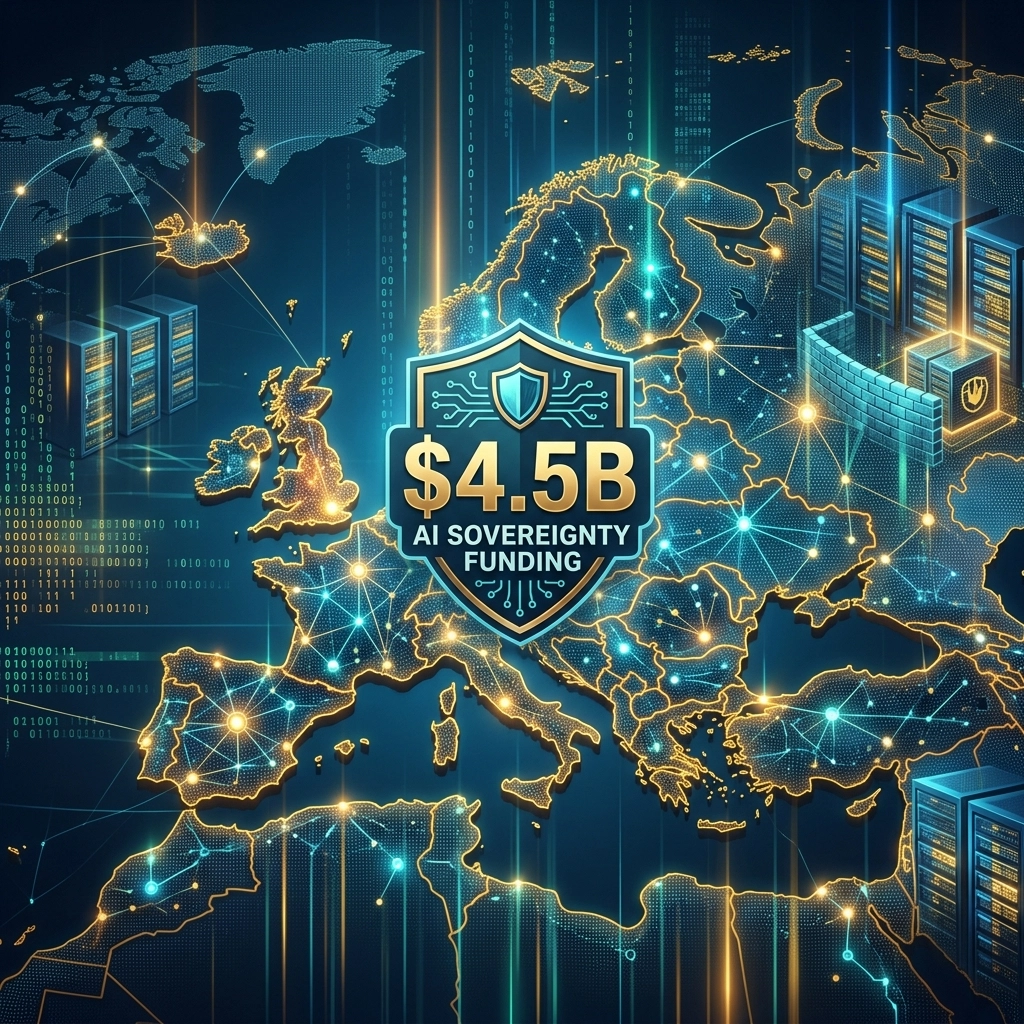
Why Everyone Is Talking About This Morning’s $4.5B AI Sovereignty Funding (And You Should Too)

In a move that has sent ripples through both the geopolitical landscape and the global technology sector, a consortium of G7 nations alongside leading sovereign wealth funds announced a landmark $4.5 billion investment dedicated exclusively to "AI Sovereignty" early this morning, April 1, 2026. This massive capital injection marks the largest single coordinated effort to date aimed at decoupling critical artificial intelligence infrastructure from globalized, third-party cloud providers in favor of nationalized, secure, and independent computational ecosystems.
The funding round, officially dubbed the "Sovereign Intelligence Initiative" (SII), underscores a fundamental shift in how nations and large-scale enterprises view their digital assets. No longer is AI seen merely as a tool for efficiency; it is now being treated as a core component of national security and economic survival. For business leaders and decision-makers, this morning's development is a clear signal that the era of "borderless AI" is rapidly concluding, replaced by a strategic race for localized control.
The Anatomy of the $4.5B Mega-Round
The $4.5 billion allocation is structured to address three primary pillars of AI independence: physical infrastructure, localized data governance, and "cultural" large language models (LLMs). Unlike previous venture-backed rounds that focused on consumer-facing applications, the SII is prioritizing the "hard" side of intelligence.
Approximately 50% of the funds are earmarked for the construction of Tier 5 data centers that operate outside the traditional jurisdiction of major hyperscalers. These facilities are designed to be energy-independent, utilizing localized power grids to mitigate the risks of global energy price volatility. This focus on the "physicality" of AI echoes recent trends we have seen in AI infrastructure matters: why today’s $4.2B funding surge redefines your 2026 scaling strategy, highlighting that without hardware control, software intelligence remains vulnerable.
The remaining capital is split between the development of proprietary chips designed specifically for sovereign workloads and the creation of "Civil LLMs": models trained on localized datasets that reflect the specific legal, linguistic, and ethical frameworks of the participating regions.

Why AI Sovereignty Has Become a Strategic Imperative
The timing of this $4.5 billion surge is not accidental. As global trade routes face increasing pressure: highlighted by recent shifts in the Strait of Hormuz and oil market volatility: the risk of relying on foreign-controlled AI stacks has become untenable for many governments.
AI Sovereignty is defined by the ability of a nation or a corporation to generate, store, and process its data using technology it owns and operates within its own borders. The risks of the "old" model were made apparent throughout 2025, where cross-border data flow regulations led to significant operational bottlenecks for multinational corporations. This morning’s funding is the definitive response to those challenges.
For the C-suite, this means that "off-the-shelf" AI solutions from global providers may soon face stricter compliance hurdles. The move toward sovereign funding suggests that the future of enterprise AI will be fragmented. Companies may need to deploy different versions of their AI stacks depending on the jurisdiction in which they operate to remain compliant with new national security standards.
The Domino Effect: Impact on Markets and Private Equity
The sheer scale of the $4.5 billion SII announcement has immediately influenced market valuations for secondary hardware suppliers and specialized cybersecurity firms. While the "Big Tech" firms remain dominant, this morning’s news suggests a growing appetite for "sovereign-grade" alternatives.
Investors are already pivoting. We have seen a series of similar, albeit smaller, rounds leading up to today, such as the $1.5B Series D AI funding surge, which focused on regional data processing. The $4.5 billion figure effectively triples down on that bet, suggesting that the "Sovereign AI" sector is no longer a niche play but a foundational market requirement.
Industry analysts suggest that this funding will trigger a "re-shoring" of data assets. Enterprises that have spent the last decade moving everything to the public cloud are now looking for ways to bring their most sensitive AI training processes back to private or "sovereign" clouds to ensure long-term stability and protection against geopolitical shocks.

Geopolitical Context: Why Now?
The global landscape in April 2026 is one of calculated maneuvers. With energy markets reacting to complex negotiations in the Middle East: specifically regarding U.S. peace offers and control of trade routes: the ability to maintain computational power without external dependency is a massive strategic advantage.
The $4.5 billion fund is, in many ways, a "defense budget" for the digital age. By securing the infrastructure for AI, the participating nations are ensuring that their economic engines can continue to run even if traditional diplomatic or trade relations are severed. This is a move toward a "multipolar" AI world, where different regions maintain their own distinct intelligence ecosystems.
What This Means for Your Q2 and Q3 Business Strategy
For CEOs and CTOs, the $4.5 billion funding round is a call to audit your AI supply chain. If your organization is heavily reliant on a single provider for both your data storage and your intelligence models, you are potentially exposed to "sovereignty risk."
- Infrastructure Diversification: Consider shifting critical workloads to localized or sovereign cloud providers. The rise in AI infrastructure funding means there are now more viable, secure alternatives than there were twelve months ago.
- Data Localization: Be prepared for tighter regulations on where AI models can be trained. The $4.5 billion SII specifically targets "at-home" training, suggesting that moving data across borders for AI processing will become increasingly difficult and expensive.
- Investment in Proprietary Models: Instead of relying on general-purpose LLMs, focus on fine-tuning smaller, specialized models that can run on independent hardware. This ensures that your company’s "intellectual core" remains within your control.

The Breakdown: Key Takeaways from the SII Announcement
- Total Funding: $4.5 Billion.
- Primary Objective: Decoupling national AI capabilities from foreign-owned cloud ecosystems.
- Key Allocations: 50% to independent data centers, 30% to sovereign chip design, 20% to localized LLM development.
- Geopolitical Trigger: Rising energy costs and maritime trade instability necessitating computational self-sufficiency.
- Corporate Impact: Higher compliance standards for data residency and a shift toward "private AI" architectures.
What to Watch Next
As the first tranches of the $4.5 billion are deployed, several key developments will determine the long-term success of this initiative:
- GPU Allotment: Watch for how the SII consortium manages the procurement of high-end chips. There is high likelihood they will attempt to bypass traditional distribution channels to secure their own supply lines.
- Regulatory Frameworks: Expect the participating nations to introduce "Sovereign AI Compliance" certifications for businesses operating within their borders by late 2026.
- Talent Migration: A $4.5 billion fund of this nature often leads to a "brain drain" from private tech giants toward state-backed sovereign projects. The competitive landscape for AI talent is about to become significantly more aggressive.
Today’s news confirms that AI is no longer just a technology story; it is a sovereignty story. Those who recognize this shift early will be best positioned to navigate the increasingly complex intersection of technology, national security, and global business.
You may also like:
- Why today’s enterprise AI integration shift will change the way you scale operations
- Looking for the next AI infrastructure unicorn? 10 things to know about today’s tech funding surge
What is your take on the rise of Sovereign AI? Is your organization prepared for a more fragmented digital landscape? Let us know in the comments below.