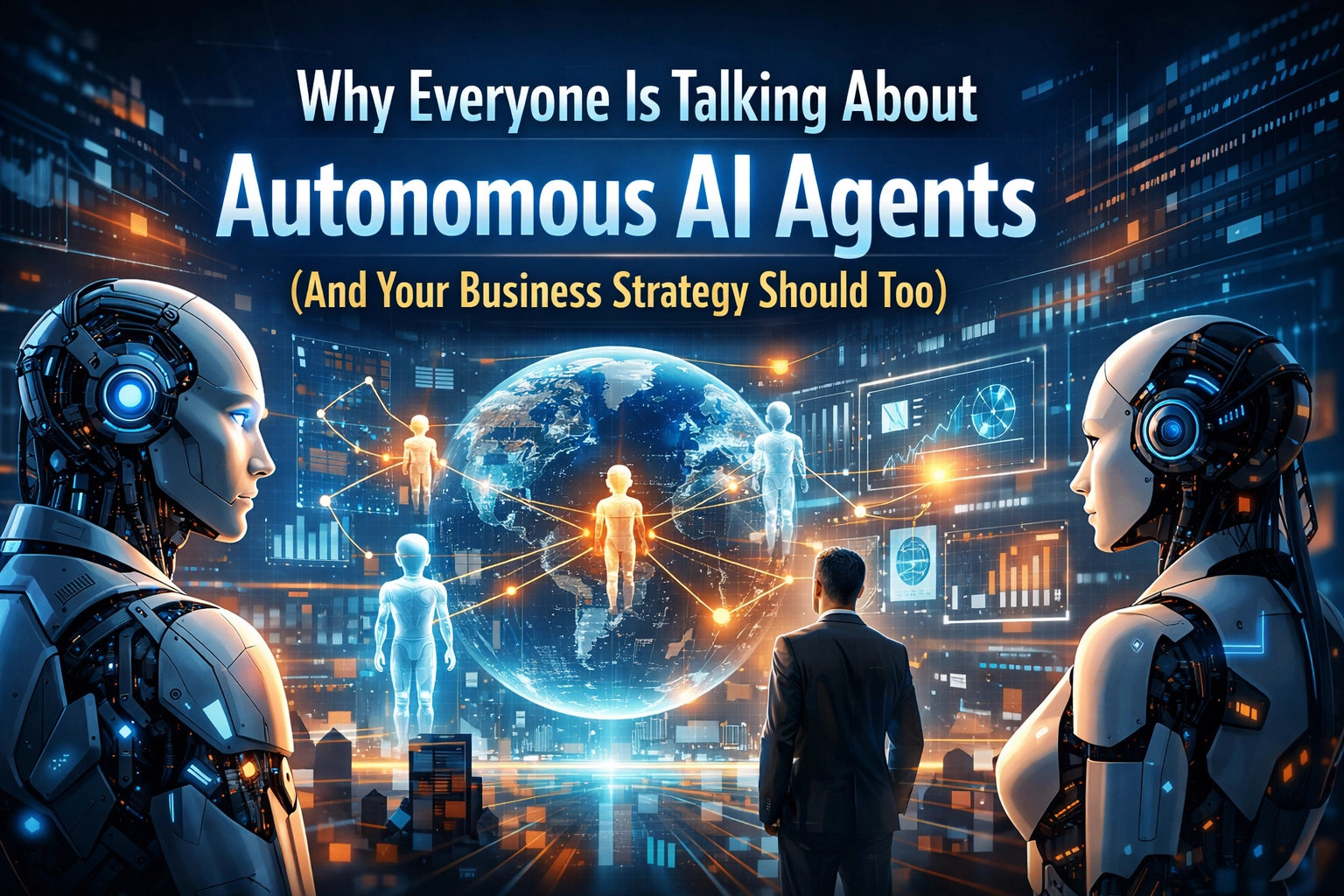
Why Everyone Is Talking About Autonomous AI Agents (And Your Business Strategy Should Too)

March 14, 2026 : The corporate landscape has reached a definitive tipping point. As of this morning, market data from the first quarter of 2026 indicates that the era of "experimental" AI has concluded, replaced by the era of "operational" autonomy. Across the globe, from Silicon Valley to the industrial hubs of Southeast Asia, the conversation has shifted from what Large Language Models (LLMs) can say to what autonomous AI agents can do.
For CEOs and business leaders, the stakes have never been higher. According to recent Gartner projections, 40% of enterprise applications have now embedded task-specific AI agents, a staggering increase from the single-digit adoption rates seen only two years ago. This transition represents more than a software update; it is a fundamental restructuring of how business operations, resource allocation, and competitive strategy are defined in 2026.
The 2026 Inflection Point: From Chatbots to Decision Engines
The primary reason for the current surge in interest: and investment: is the shift in the underlying architecture of AI. In 2024 and 2025, businesses primarily utilized "copilots" or assistive tools that required constant human prompting and oversight. Today, the focus is on Autonomous AI Agents: systems capable of reasoning about complex objectives, planning multi-step sequences of actions, and executing those tasks independently without human intervention.
These agents are no longer confined to digital sandboxes. They are now integrated into core business infrastructure, managing everything from real-time supply chain adjustments to automated financial reconciliation. The maturation of "agentic orchestration" platforms has allowed enterprises to deploy these systems with the governance and security frameworks required for production environments.

Measurable Business Impact: The Data Behind the Hype
The momentum behind autonomous agents is driven by quantifiable results that are reshaping balance sheets. Current industry reports for March 2026 highlight several key performance indicators:
- Productivity Surges: Large enterprises experimenting with agentic workflows report up to a 200% surge in productivity for specific administrative and analytical tasks.
- Cost Efficiency: In the customer service sector, organizations deploying autonomous agents have seen ticket volumes handled by humans drop by 30-50%, while customer satisfaction (CSAT) scores have remained stable or improved due to 24/7 availability and instant resolution times.
- Compressed Timelines: Complex research tasks, such as market analysis or legal discovery that previously required a full day of human effort, are now being completed by agents in under two hours with equal or superior accuracy.
For a broader look at how these developments are affecting the global business environment, visit our latest news updates.
Significance: Why Your Strategy Must Adapt Now
The rapid adoption of AI agents is not occurring in a vacuum. It is coinciding with significant global economic shifts and geopolitical tensions that demand higher operational agility. As trade dynamics evolve, particularly with the U.S.-China trade truce being tested by fresh investigations, businesses are turning to AI agents to navigate the complexities of global compliance and supply chain rerouting.
1. Function-Specific Autonomy
AI agents are being deployed across every department. In HR, agents handle end-to-end recruitment pipelines, from sourcing to preliminary technical interviews. In finance, agents manage autonomous cloud cost optimization, identifying and rectifying waste in real-time. This level of function-specific autonomy allows human leaders to move away from micro-management and toward high-level strategic direction.
2. Democratization of Operational Capacity
One of the most profound shifts in 2026 is the democratization of scale. A mid-sized business with 20 employees can now utilize autonomous agents to handle functions: such as localized marketing across 50 regions or complex logistical coordination: that previously required a back-office staff of 200. This resets the efficiency expectations across all market segments.
3. Embedded Governance
Unlike the early days of AI, where compliance was often an afterthought or a barrier to adoption, 2026's agentic systems have governance built into their "DNA." Logic for policy enforcement, audit readiness, and risk monitoring is embedded directly into the workflow. This allows for scaled automation that is inherently compliant with regional regulations, such as the latest global labor trade probes.

Implications for Global Trade and Security
The rise of autonomous systems is also impacting how businesses respond to global crises. For instance, in the energy and shipping sectors, agents are being used to simulate and respond to maritime disruptions. As the U.S. considers naval escorts in the Strait of Hormuz, AI-driven predictive logistics agents are already rerouting fleets and hedging fuel costs to mitigate the impact of potential conflict.
Furthermore, the integration of AI into social and political spheres is accelerating. High-stakes communication, once the sole province of diplomats and PR firms, is now being monitored and responded to by AI systems that analyze sentiment and risk in real-time. This is particularly relevant as international leaders continue to utilize platforms like Elon Musk's X to broadcast strategic shifts amid heightened tensions.
The Cost of Inaction
For CEOs, the risk of "waiting and seeing" has become an existential threat. The orchestration infrastructure for production-grade AI agents already exists. Competitors who integrate these systems now are not just saving money; they are building a data and operational advantage that compounds over time. Organizations that fail to incorporate autonomous agents into their 2026–2027 strategic plans risk permanent operational inefficiency relative to their "agent-first" peers.

What to Watch Next
As we look toward the remainder of 2026, several key developments will determine the trajectory of autonomous AI:
- Agent-to-Agent Economies: Watch for the emergence of "agent marketplaces" where AI systems from different companies negotiate and execute transactions with each other without human intervention.
- Regulatory Frameworks: Expect a surge in legislative activity as governments attempt to define legal liability for autonomous decisions, particularly in sectors like healthcare and autonomous transport.
- Hardware Evolution: The demand for agentic AI is driving a new wave of localized "edge" computing power, reducing the reliance on centralized cloud servers and increasing the speed of execution.
- Political Influence: As seen with billionaires ramping up political spending, the intersection of tech-driven wealth and political influence will likely shape the regulatory environment for AI agents.
The conversation about AI has moved beyond the "if" and firmly into the "how." For the modern CEO, the directive is clear: move past the pilot phase and begin the hard work of integrating autonomous agents into the core of your business strategy.
You may also like:
- The Future of Global Trade Investigations and Their Impact on Tech
- Navigating Geopolitical Tensions in a Digital Age
- Strategic Planning for Energy Security Amidst Naval Crises
What is your organization’s biggest hurdle in deploying autonomous AI agents this year? Let us know in the comments below.