
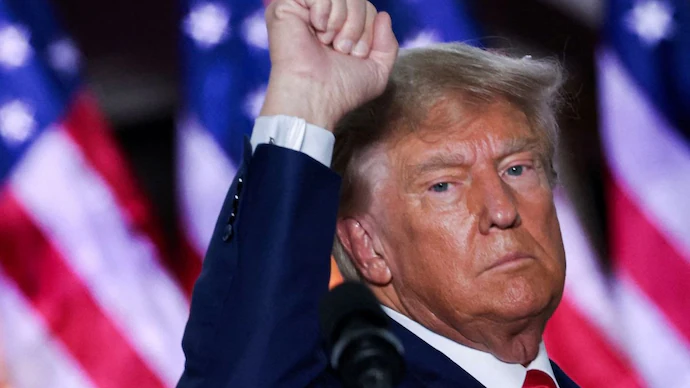
Trump Claims ‘Everything’s OK’ as Wall Street Worries: Is the U.S. Economy Really in a ‘Transition’ or Headed for Trouble?

Trump Downplays Recession Fears, Calls U.S. Economy a ‘Transition Period’ – Is He Right?
As market jitters rise and recession whispers grow louder, former President Donald Trump is striking a very different tone. In a recent public statement, Trump described the U.S. economy as being in a “transition period”, insisting that “everything’s OK” and that the country will soon be doing “fantastically.”
Trump’s reassurances come at a time when Wall Street is growing uneasy, with investors reacting to ongoing tariff pressures, shifting global trade dynamics, and signs of slowing economic momentum. Despite the noise, Trump remains unshaken—but is that confidence grounded in reality?
What Did Trump Say?
Speaking to reporters, Trump dismissed concerns about economic instability, choosing instead to paint the current climate as a temporary adjustment. “We’re in a transition period,” he said, suggesting that the U.S. economy is gearing up for future growth rather than slipping into decline.
He emphasized optimism, calling on Americans to remain confident in the country’s direction and insisting that a rebound is coming. While he didn’t offer specifics, his tone was clear: there’s nothing to worry about.
Why Wall Street Isn’t So Sure
While Trump talks optimism, financial markets are telling a more cautious story:
- Tariff tensions with key trading partners, especially China, have caused supply chain disruptions and uncertainty in manufacturing and tech sectors.
- Recent job growth figures have been softer than expected, raising eyebrows about underlying economic strength.
- Consumer confidence has shown signs of wavering—especially among middle-income households squeezed by inflation and rising interest rates.
Economists argue that a “transition period” is an optimistic way of describing what might actually be the early stages of a slowdown.
What Does ‘Transition Period’ Really Mean?
Trump didn’t elaborate on what this “transition” entails—but based on past rhetoric, it’s likely a reference to:
- Shifting from a globalized to a more domestically focused economy, especially in areas like energy and manufacturing.
- Moving away from trade dependence on nations like China, which has sparked tensions and tariffs.
- Preparing for long-term infrastructure investments and supply chain realignment—both costly and time-consuming undertakings.
While these transitions may lead to stronger U.S. production capacity in the long term, they often come with short-term pain: job dislocation, market uncertainty, and volatile consumer prices.
Is Trump’s Optimism Just Politics?
Critics argue that Trump’s upbeat tone may have more to do with political positioning than economic reality. With the 2024 election still echoing, and a potential comeback in 2028 already being teased, maintaining a narrative of control and optimism is a familiar strategy.
But economists note that minimizing early warning signs can lead to policy missteps, as seen in previous financial downturns.
What’s the Outlook?
The U.S. economy is undeniably in flux. Whether it’s a “transition” or the beginning of a downturn is still up for debate. Key indicators to watch in the coming months include:
- Consumer spending and credit card debt trends
- Corporate earnings reports, especially in retail and tech
- Federal Reserve policy, particularly on interest rates
- Geopolitical tensions and their impact on trade flows
If Trump is right, we’ll see stabilization and renewed growth by early 2026. If Wall Street’s concerns are justified, the U.S. could be facing a sharper correction than anyone in politics wants to admit.
Final Thoughts: Reassurance or Red Flag?
Trump’s insistence that “everything’s OK” may comfort some, but for many investors and analysts, it sounds more like a political soundbite than a financial forecast.
The truth? The U.S. may very well be in a transition—but whether that leads to a booming economy or a bruising downturn depends on decisions made now. Watch closely.

