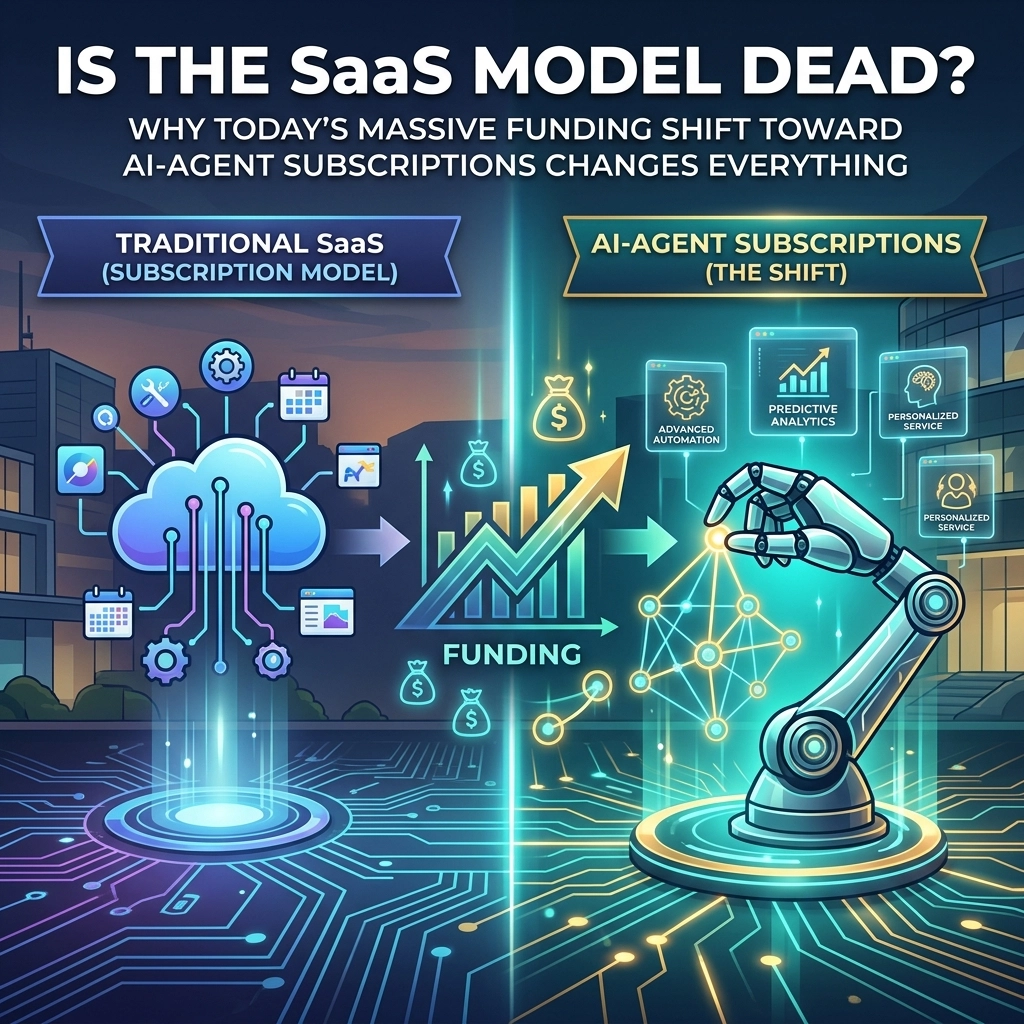
Is the SaaS Model Dead? Why Today’s Massive Funding Shift Toward AI-Agent Subscriptions Changes Everything

On this Sunday, April 12, 2026, the global software-as-a-service (SaaS) landscape is navigating a fundamental structural realignment. Recent venture capital data and market analysis indicate that the traditional per-seat subscription model: the cornerstone of enterprise software for over two decades: is rapidly being superseded by AI-agent-centric platforms. This shift represents more than a change in technology; it is a total metamorphosis of the economic relationship between software providers and corporate buyers.
As of early April 2026, major funding rounds have pivoted away from "tool-based" SaaS toward "agentic" systems. These systems do not merely provide an interface for human workers to perform tasks; they execute the tasks autonomously. Consequently, the "per-user" pricing model is becoming an obsolete metric for value, forcing industry incumbents and startups alike to reinvent their revenue strategies in real-time.
The Death of the "Per-Seat" Metric
For twenty years, the success of a SaaS company was measured by its ability to expand the number of "seats" or licenses within a customer organization. In the current 2026 market, this model has encountered a logical wall. If an AI agent can perform the workload of five full-time employees, a corporation has no incentive to pay for five software seats.
Current market data suggests that pure seat-based pricing is on a trajectory to become obsolete by 2028. Today’s funding shifts show that investors are now prioritizing companies that utilize "outcome-based" or "consumption-based" pricing. Under these models, companies pay for the successful completion of tasks: such as a resolved customer support ticket, a generated legal brief, or a completed architectural render: rather than the number of human logins.
This transition is creating a "value-per-task" economy. While traditional SaaS focused on productivity tools, AI-agent subscriptions focus on automated labor. This distinction is the primary driver behind the massive capital reallocation seen in the first two quarters of 2026.

Strategic Reallocation: Following the $4.2B Infrastructure Surge
The shift toward agentic software is heavily predicated on the massive investments in backend capabilities. This morning’s reports echo the trend we saw earlier this month regarding the 4.2B AI infrastructure surge, which provided the necessary compute power for autonomous agents to operate at scale.
Venture capital is no longer interested in the "wrapper" startups that simply add a chat interface to existing databases. Instead, the current funding environment favors "full-stack agentic platforms." These are systems that can build, run, orchestrate, and govern autonomous agents across multiple business functions. This infrastructure-heavy approach ensures that the agents are not just digital assistants, but reliable components of the enterprise workforce.
Horizontal vs. Vertical SaaS: A Divergent Fate
The impact of this funding shift is not uniform across all software categories. Analysis of today's market trends reveals a stark divide between horizontal point solutions and vertical-specific platforms.
1. The Vulnerability of Horizontal SaaS
Horizontal SaaS: tools like generic CRM, basic project management, and general communication platforms: face the highest risk of disruption. Because these tools often have low switching costs and provide generalized features, they are easily replicated by AI agents that can interact with raw data via APIs. Funding for general-purpose SaaS has plummeted by an estimated 40% year-over-year as of April 2026, as investors fear "feature commoditization."
2. The Resilience of Vertical SaaS
Conversely, vertical-specific SaaS: platforms built for highly regulated or complex industries like healthcare, manufacturing, or maritime trade: remains a stronghold for investment. These platforms possess deep domain expertise and proprietary datasets that are difficult for generalized AI to navigate. In these sectors, the "agent" is an expert assistant integrated into a complex workflow, making the software more "sticky" and valuable to the end-user.

The Response of Enterprise Giants
Incumbent giants like Salesforce, Oracle, and ServiceNow are not remaining stagnant. Recognizing the threat to their traditional revenue streams, these organizations have begun a rapid transition toward "agentic orchestration."
During the most recent earnings calls, leadership at these firms emphasized a shift toward "capability-based" billing. They are embedding autonomous agents directly into their ecosystems, allowing customers to "hire" digital workers for specific roles within the CRM or ERP. This move is a strategic attempt to capture the value of the work performed, rather than just the license to the tool.
However, these incumbents face the "innovator's dilemma." Transitioning from high-margin seat-based revenue to potentially more volatile outcome-based revenue requires a total overhaul of sales commissions, financial forecasting, and investor expectations.
Significance and Economic Implications
The shift toward AI-agent subscriptions has three primary implications for the global business ecosystem:
- ROI Compression: The time to achieve Return on Investment (ROI) is shrinking. Autonomous agents can be deployed and begin producing results significantly faster than human teams can be trained on new software.
- Labor Market Decoupling: Historically, software growth and white-collar hiring were positively correlated. In the agentic era, we are seeing a "decoupling," where corporate output can increase even as software seat counts: and potentially headcounts: remain flat or decline.
- Data Sovereignty as Currency: As agents become the primary users of software, the value of the underlying data increases. The ability to provide "clean," high-context data to an agent is now more valuable than the user interface (UI) through which a human would have accessed that data.

What to Watch: The Next 12 Months
As we look toward the remainder of 2026 and into 2027, several key developments will determine the long-term viability of the agentic subscription model:
- Standardization of Outcome Metrics: The industry must reach a consensus on what constitutes a "successful task." Without standardized metrics, outcome-based billing will remain difficult for procurement departments to verify.
- Regulatory Oversight of Autonomous Actions: As agents take on more autonomous decision-making in sectors like finance and legal, regulatory bodies may introduce "human-in-the-loop" mandates, which could temporarily bolster the seat-based model by requiring human oversight licenses.
- The Rise of "Agent-to-Agent" Economies: We are approaching a point where software agents will buy services from other software agents. This "machine-to-machine" commerce will require entirely new billing protocols that do not involve human intervention or traditional subscription tiers.
The SaaS model is not "dead" in the sense of disappearance; it is undergoing a fundamental re-coding. The capital shift we are witnessing today, April 12, 2026, confirms that the era of software as a "tool" is ending, and the era of software as "labor" has begun. For business leaders, the challenge is no longer just selecting the right tools, but managing a hybrid workforce of humans and autonomous agents integrated through a new generation of subscription models.
You may also like:
- Why everyone is talking about this morning’s $3.8B AI infrastructure surge
- The Future of Enterprise AI: Insights from the C-Suite
- Startup Funding Trends in 2026: The Agentic Pivot
What is your organization's strategy for transitioning from per-seat software to outcome-based AI agents? Join the conversation in the comments below.
Categories: News, Technology, Business News, CEOs