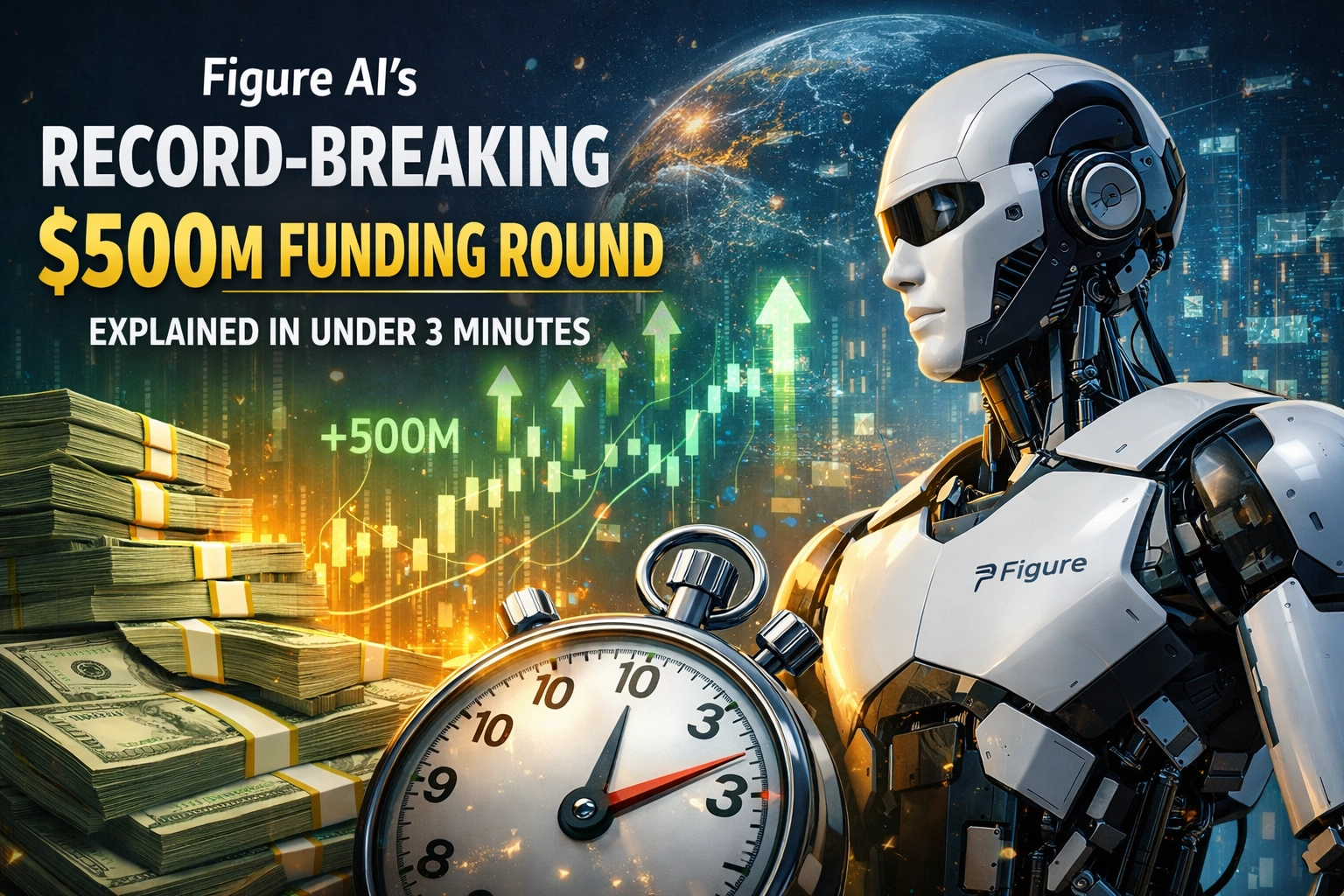

On March 15, 2026, Figure AI officially closed a massive Series C funding round that has effectively redefined the valuation metrics for the humanoid robotics industry. While early market reports initially pointed toward a $500 million injection, breaking updates from internal sources and lead investors confirm the final figure has eclipsed $1 billion, propelling the company to a staggering $39 billion post-money valuation. This capital surge represents the largest single investment in a humanoid robotics startup to date, signaling a definitive shift from experimental prototyping to large-scale commercial deployment.
The round was spearheaded by Parkway Venture Capital, with substantial participation from a coalition of technology titans including NVIDIA, Microsoft, and the OpenAI Startup Fund. Additional backing came from institutional heavyweights such as Brookfield Asset Management, Intel Capital, and T-Mobile Ventures. This funding is specifically earmarked for the mass production of the Figure 02 and Figure 03 models, the expansion of the company’s proprietary Helix AI system, and the aggressive scaling of robot-as-a-service (RaaS) models across North American manufacturing hubs.
The Capital Influx: From $500 Million to $1 Billion
The trajectory of this funding round highlights the explosive demand for "Physical AI": the integration of advanced large language models (LLMs) with high-dexterity robotic hardware. Initially, Figure AI was in discussions for a $500 million round led by Microsoft and OpenAI. However, as the performance metrics for Figure’s latest models exceeded internal benchmarks for autonomous reasoning and tactile sensitivity, investor interest surged.
By the time the round closed this morning, the total investment had doubled the initial expectations. This $1 billion+ Series C serves as a clear indicator that venture capital is moving away from purely digital AI applications toward the "real-world" embodiment of artificial intelligence. The primary goal of this capital is to transition Figure AI from a research-intensive entity into a global manufacturer capable of producing thousands of humanoid units annually.

Strategic Alliances: The Power of the NVIDIA-Microsoft-OpenAI Triad
The composition of Figure AI’s investor list is as significant as the dollar amount. Each major participant brings more than just capital; they provide the infrastructure necessary for the humanoid ecosystem to thrive.
- NVIDIA: Provides the heavy-duty GPU infrastructure required to train the "Helix AI" system. Figure robots rely on NVIDIA’s Jetson Thor modules for real-time edge computing, allowing the robots to navigate complex, unstructured environments without constant cloud tethering.
- Microsoft: As the primary cloud partner, Microsoft’s Azure platform hosts the massive data sets generated by Figure’s fleet. This partnership also hints at deeper integration with Microsoft’s enterprise software, potentially allowing the robots to receive instructions via standard office productivity tools.
- OpenAI: The collaboration with OpenAI focuses on "visual-to-speech" and "vision-language" models. This allows Figure’s robots to understand complex verbal commands and describe their surroundings to human coworkers, making them intuitive to operate on factory floors.
The inclusion of T-Mobile Ventures and Intel Capital further underscores the importance of 5G connectivity and specialized silicon in the next generation of robotics. As these robots begin operating in massive logistics centers, low-latency communication provided by 5G will be essential for fleet management and safety protocols.
Technical Milestones: Scaling Helix AI and General-Purpose Utility
At the heart of Figure AI’s value proposition is the Helix AI system. Unlike traditional industrial robots that are programmed for a single, repetitive task, Figure’s humanoid robots are designed for general-purpose utility. They utilize end-to-end neural networks to learn tasks through observation and simulation, a process known as "imitation learning."
With the new funding, Figure AI is launching an advanced data collection effort. By deploying hundreds of robots into controlled pilot programs, the company can gather millions of hours of interaction data. This data is then used to refine the robots’ perception and reasoning capabilities. The goal is a machine that can walk into a new warehouse, observe the workflow for a few hours, and begin contributing to the labor force without manual coding.

Significance: The Competitive Landscape and the Labor Crisis
The timing of this funding round is not accidental. The global manufacturing and logistics sectors are facing a projected labor shortage of millions of workers by 2030. Humanoid robots are increasingly viewed not as a replacement for human workers, but as a necessary supplement to maintain supply chain stability.
Market Implications:
- The "Optimus" Factor: This funding places Figure AI in direct competition with Tesla’s Optimus project. While Tesla benefits from its automotive manufacturing expertise, Figure’s open collaboration with multiple tech giants gives it a broader ecosystem of software and hardware support.
- Valuation Parity: At a $39 billion valuation, Figure AI is now valued higher than several established legacy robotics companies. This reflects a "software-first" valuation model applied to hardware, betting on the exponential growth of AI capabilities.
- Industrial Integration: The involvement of Brookfield Asset Management is particularly telling. As one of the world’s largest real estate and infrastructure investors, Brookfield’s participation suggests a future where humanoid robots are integrated into the very design of commercial and industrial buildings.

Geopolitical and Economic Impacts
The move to scale humanoid robotics in the United States is also a strategic play in the ongoing global trade tensions. As companies seek to "reshore" manufacturing to avoid the complexities of international trade disputes, the high cost of domestic labor remains a barrier. Automation via humanoid robots provides a potential solution to this economic hurdle.
For more insights into how trade policies are shaping the business landscape, you may be interested in our coverage of the U.S.-China trade truce testing and the ongoing Strait of Hormuz crisis, both of which are driving the push for domestic manufacturing independence.
What to Watch: The 2026-2027 Roadmap
With the Series C successfully concluded, Figure AI is moving into its most critical phase: mass deployment. Here is what industry leaders and decision-makers should monitor over the next 12 to 18 months:
- Commercial Pilots: Watch for announcements regarding large-scale deployments in automotive assembly plants and retail fulfillment centers. Figure has already established a partnership with BMW, and more "Big Auto" names are expected to follow.
- Safety Standards: As humanoid robots move out of cages and into shared spaces with humans, the establishment of federal safety standards for "Mobile Collaborative Robots" will be a major legislative hurdle.
- The "Robot-as-a-Service" Model: Instead of selling robots for $100,000+ per unit, Figure is expected to lean into a subscription model. This reduces the capital expenditure for businesses and ensures a recurring revenue stream for Figure.
- Hardware Iteration: Rumors suggest a "Figure 03" model is already in the prototyping phase, featuring enhanced battery life (aiming for a full 8-hour shift) and improved "liquid-state" actuators for more fluid motion.

The record-breaking funding of Figure AI is more than just a financial headline; it is the starting gun for the humanoid era. For business leaders, the question is no longer if these machines will enter the workforce, but how quickly they can be integrated into existing operations to maintain a competitive edge.
To stay updated on the latest shifts in the AI and business world, explore our news sitemap or check out our featured analysis.
What do you think?
Will Figure AI's $39 billion valuation hold up as they move to mass production, or is the humanoid market heading toward a "hype bubble"? Share your thoughts in the comments below.
You may also like: