
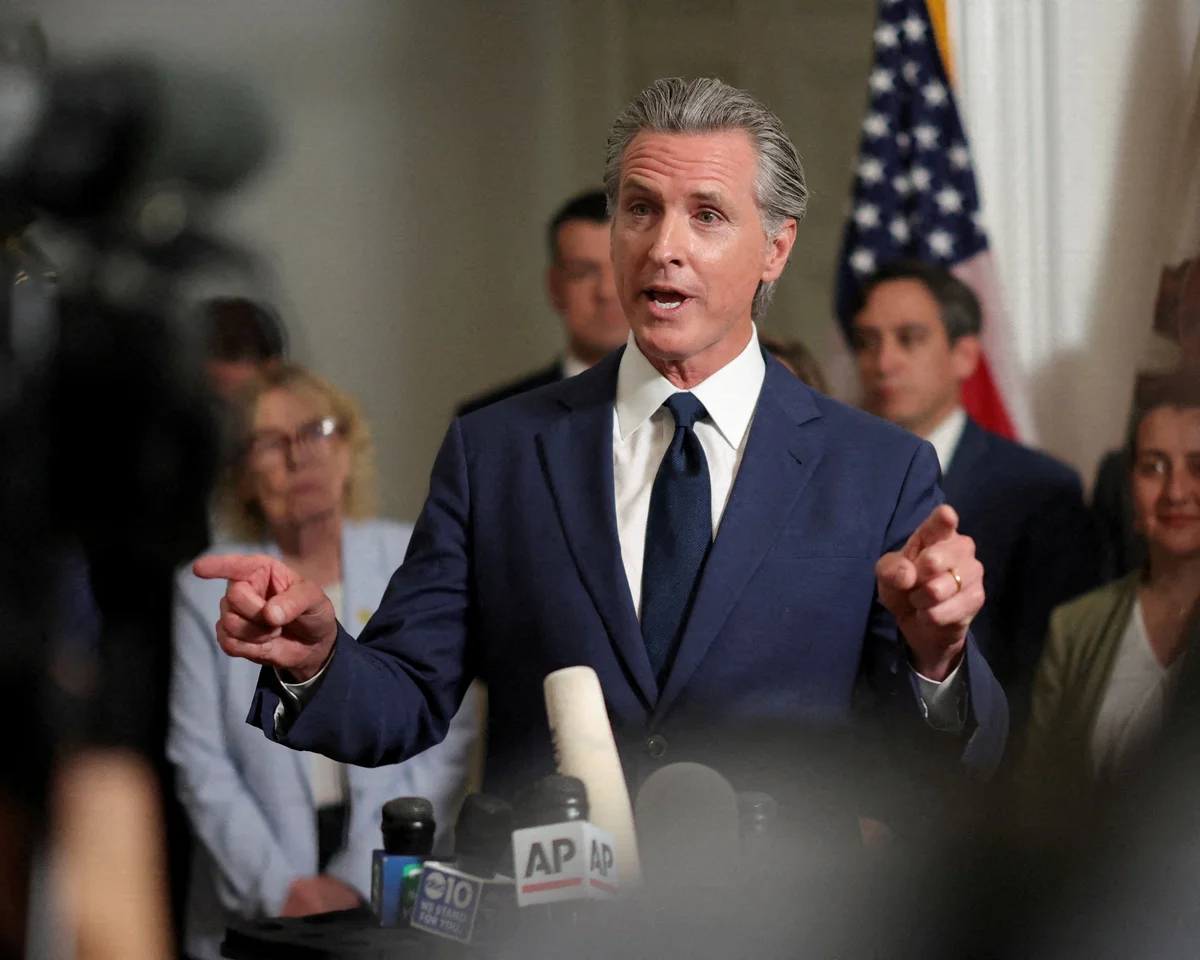
California Fires Back: Newsom Signs New Voting Map to Flip Five House Seats Blue

California Governor Gavin Newsom signed a bold new redistricting measure on Thursday that could reshape the national political map — and the balance of power in Congress. The proposal redraws the state’s congressional districts to create five new Democratic-leaning US House seats, setting up what’s being called a direct counterattack against Republican-led gerrymandering efforts in Texas and other red states.
The move marks one of the most aggressive political plays by California Democrats in recent years, and it’s already stirring fierce debate on both sides of the aisle.
The redistricting bill, which passed the Democratic-controlled legislature after hours of tense debate, now heads to voters in a special election this November. If approved, the changes would go into effect for the 2026 midterms — potentially giving Democrats a much-needed boost in their effort to retake the House.
In signing the measure, Newsom was unapologetic. “If Texas and Florida want to rig the rules to lock in minority rule, California will not sit back and watch,” he said in a brief statement. “This is about fairness, representation, and fighting fire with fire.”
The bill’s passage follows growing frustration among national Democrats over Republican-led redistricting maneuvers that have heavily favored the GOP in key battleground states. In Texas, for example, the latest voting maps are widely seen as designed to protect Republican incumbents and dilute the voting power of urban and minority communities.
While California has historically relied on an independent redistricting commission, this proposal — backed by legislative Democrats and now signed by Newsom — bypasses that process. Supporters argue it’s a necessary step to restore balance after what they describe as a decade of GOP gerrymandering across the country.
Critics, however, accuse Democrats of hypocrisy.
“It’s gerrymandering, plain and simple,” said Republican strategist Kyle Reyes. “Democrats have spent years railing against partisan maps, and now they’re doing the exact same thing in the bluest state in America. If they were serious about fairness, they’d strengthen the independent process, not undermine it.”
But supporters of the bill argue that it’s not about partisanship — it’s about protecting democracy in a system that’s already been skewed beyond recognition. “We’re not going to let one party rig the entire game,” said State Assembly Majority Leader Adriana Vega. “This is about leveling the field, not tilting it.”
The new map would primarily affect congressional districts in Southern California and parts of the Central Valley — areas where shifting demographics and voter trends have already made elections more competitive. Under the proposed changes, five Republican-held seats would become significantly more favorable to Democrats, based on recent voting data.
Redistricting experts say the plan could help Democrats claw back seats lost in recent cycles — and reshape the party’s long-term strategy.
“If this goes through, it’s a big deal,” said a nonpartisan political analyst. “Five seats in California is the kind of swing that could decide control of the House. This is no small maneuver.”
The national implications are clear. Democrats are still smarting from the 2022 and 2024 election cycles, where despite winning the popular vote in multiple states, they lost out in congressional representation due to GOP-favored district maps. The California proposal is the first major attempt by Democrats to directly push back.
The White House has not commented on the bill, but party leaders in Washington are closely watching how the special election plays out in November. If California voters approve the plan, it could set a precedent for other blue states to follow suit — especially if the courts continue to allow Republican-friendly maps to stand in red states.
Still, there are legal hurdles ahead. Republican lawmakers in California are expected to challenge the proposal in state court, arguing that it violates constitutional protections and undermines the state’s long-standing redistricting commission. Voting rights groups are also split — some support the idea as a defensive move, while others worry it opens the door to more partisan manipulation on both sides.
Despite the controversy, the proposal has energized Democratic activists heading into the fall.
“This is what fighting back looks like,” said Maya Cortez, a campaign organizer based in Los Angeles. “We’re done playing defense while the other side rigs the system. It’s time to be bold.”
Meanwhile, Republicans are preparing their counter-narrative, accusing Newsom and California Democrats of abandoning their own principles in pursuit of raw political power. The outcome of the special election could become a litmus test for voters: are they willing to embrace partisan tactics to correct what many see as a broken system — or will they reject what looks like more of the same from the other side?
As the national debate over voting rights, district maps, and political power continues to heat up, California has made its position clear: it’s no longer sitting on the sidelines.

