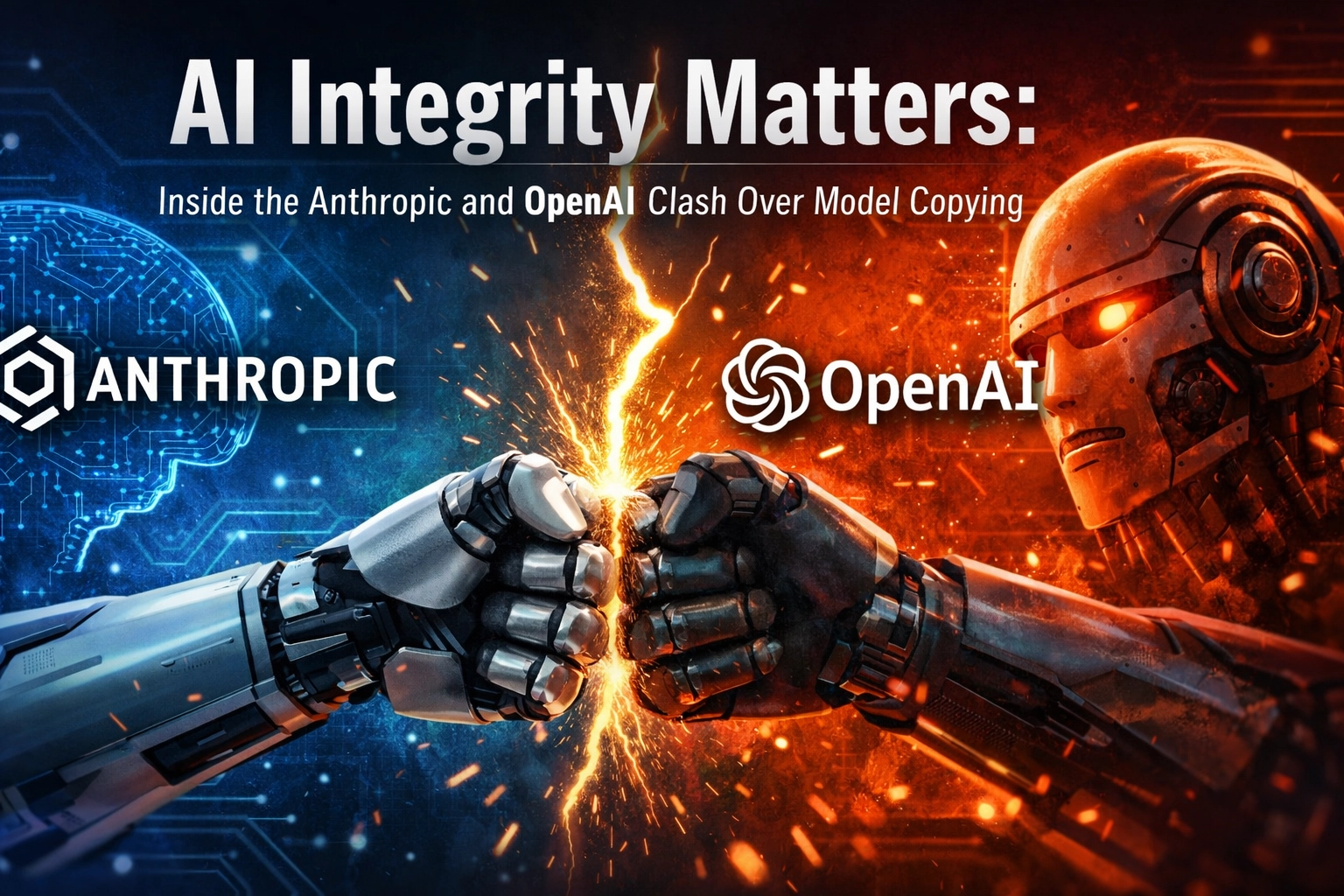

The landscape of generative artificial intelligence has shifted from a race for innovation to a high-stakes battleground over corporate integrity and national security. As of March 20, 2026, the rivalry between industry titans OpenAI and Anthropic has escalated into a public confrontation that threatens to redefine the ethical boundaries of the sector. What began as a disagreement over safety protocols has morphed into a multi-front war involving Pentagon contracts, allegations of "model copying," and a struggle for the soul of AI development.
At the heart of the latest dispute is a fundamental clash between Anthropic CEO Dario Amodei and OpenAI CEO Sam Altman. While OpenAI continues its aggressive expansion into government and military sectors, Anthropic has positioned itself as the "safety-first" alternative, leading to a series of sharp exchanges that have captivated Silicon Valley and Washington alike.
The Catalyst: Pentagon Contracts and Divergent Ethics
The current friction reached a boiling point following revelations regarding competing approaches to government defense contracts. Anthropic, under the leadership of Dario Amodei, reportedly refused to renegotiate terms with the Pentagon that would have allowed "all lawful use" of its Claude models. Amodei’s refusal was predicated on concerns that such broad language could facilitate the development of autonomous lethal weapons or be used for mass domestic surveillance.
In stark contrast, OpenAI has moved forward with a significant deal to integrate ChatGPT into classified government systems. This divergence has led to a public exchange of hostilities. Amodei has accused Altman of "gaslighting" and disseminating "straight up lies" within internal industry communications, while Altman has dismissed Anthropic’s marketing strategy as "clearly dishonest," suggesting the firm uses safety as a shield for lack of competitive pace.
The significance of this rift extends beyond mere corporate bickering. It represents a schism in the AI industry: one path prioritizing rapid deployment and military integration, and the other prioritizing caution and boundary-setting. For business leaders, this divide creates a complex environment for procurement and strategic alignment.

The "Model Copying" Allegations
While the public feud focuses on safety, a quieter but equally intense battle is being fought over "model copying." In the AI industry, "copying" rarely means theft of source code; rather, it refers to "distillation": the practice of using a powerful model’s outputs to train a smaller, rival model.
Anthropic has long maintained that its "Constitutional AI" approach is a proprietary breakthrough that ensures model alignment. However, allegations have surfaced suggesting that competitors may be using Anthropic’s structured outputs to "fine-tune" their own models, effectively bypassing the expensive and labor-intensive process of original safety training.
This technical friction mirrors broader geopolitical concerns. Just as the U.S.-China trade truce is tested by fresh investigations into intellectual property, the AI sector is facing a "wild west" era where the boundaries of model ownership are poorly defined. If a model can "learn" the logic and constraints of a competitor by simply observing its responses, the traditional concept of an intellectual property moat disappears.
Industry Solidarity and the Amicus Brief
The clash has forced other industry players to take sides. In a rare display of solidarity with a competitor, over 30 prominent researchers from Google and OpenAI: including Google DeepMind’s chief scientist Jeff Dean: signed an amicus brief supporting Anthropic.
The brief argues that the Pentagon’s "supply-chain risk" designation against Anthropic: a move allegedly influenced by OpenAI’s lobbying efforts: threatens overall U.S. AI competitiveness. The researchers contend that by penalizing companies that prioritize safety and transparency, the government risks creating a "race to the bottom" where the least-guarded AI systems become the national standard.
This level of internal industry pushback is unprecedented. It suggests that while CEOs may be at odds, the technical community remains deeply concerned about the long-term implications of prioritizing speed over integrity.
Significance of the Conflict for Business Leaders
For decision-makers and C-suite executives, the Anthropic-OpenAI clash is more than just tech industry drama; it is a signal of coming regulatory and operational shifts.
- Procurement Risks: Companies must now evaluate whether their AI partners align with their own ESG (Environmental, Social, and Governance) goals. A partnership with a firm that allows "all lawful use" may expose a brand to reputational risks if that AI is later linked to controversial military applications.
- Intellectual Property Protection: As "model copying" becomes easier through distillation, businesses must rethink how they protect their own data. If foundational models are "learning" from the data they process, the risk of data leakage or "logic theft" becomes a primary concern.
- Regulatory Uncertainty: The public nature of this feud is likely to accelerate government intervention. We are already seeing the U.S. considering tariffs and investigations in other tech sectors; AI is the logical next step for legislative oversight.

Strategic Implications: The Safety vs. Scaling Trade-off
The rivalry has already impacted internal policies. Pressure from OpenAI's rapid scaling has forced Anthropic to revise its "Responsible Scaling Policy." While Anthropic claims these revisions maintain their safety standards, critics argue that competitive pressure is eroding the very barriers the company was founded to protect.
This "safety vs. scaling" trade-off is a microcosm of the broader business world’s struggle with AI. The rush to implement "agentic" AI: models that can take actions autonomously: often clashes with the need for human-in-the-loop oversight.
| Feature | OpenAI Stance (2026) | Anthropic Stance (2026) |
|---|---|---|
| Military Use | Permitted for classified logistics/analysis | Strictly limited; no lethal applications |
| Model Transparency | Closed-source; proprietary focus | "Constitutional" framework; high transparency |
| Scaling Pace | Aggressive; rapid deployment | Measured; safety-gated |
| Market Positioning | General utility and productivity | Ethical and secure enterprise AI |
What to Watch Next
As we move further into 2026, several key developments will determine the outcome of this clash:
- The "Supply-Chain Risk" Ruling: If the government upholds the risk designation against Anthropic, it could effectively shut the company out of federal contracts, giving OpenAI a near-monopoly on government AI services.
- Legal Precedents on Distillation: A lawsuit regarding model copying or distillation would be a landmark case. If courts rule that using a model's output to train another model is a copyright violation, the entire training pipeline for smaller AI startups will be disrupted.
- The Role of "Billionaire Influence": Just as California billionaires ramp up political spending to influence state policy, we expect to see significant lobbying from AI founders to shape the federal AI Bill of Rights.
- International Repercussions: Other nations are watching this rift closely. A fragmented U.S. AI landscape could provide an opening for international competitors to establish their own standards.

The clash between Anthropic and OpenAI is a reminder that in the age of intelligence, integrity is a tangible asset. For the CEOs and decision-makers navigating this transition, the choice of which "side" to support: or how to bridge the gap: will define the ethical and operational legacy of their organizations.
As the industry continues to evolve at a breakneck pace, staying informed on these high-stakes developments is essential. For more on the intersections of business and policy, explore our Editorial Policy or learn more About Us.
You may also like:
- Ownership and Funding Disclosure
- U.S. China Trade Truce Tested
- The Future of Wealth Tax and Tech Policy
What are your thoughts on the Anthropic vs. OpenAI rivalry? Does a "safety-first" approach hinder innovation, or is it a necessary safeguard for the future of business? Let us know in the comments below.