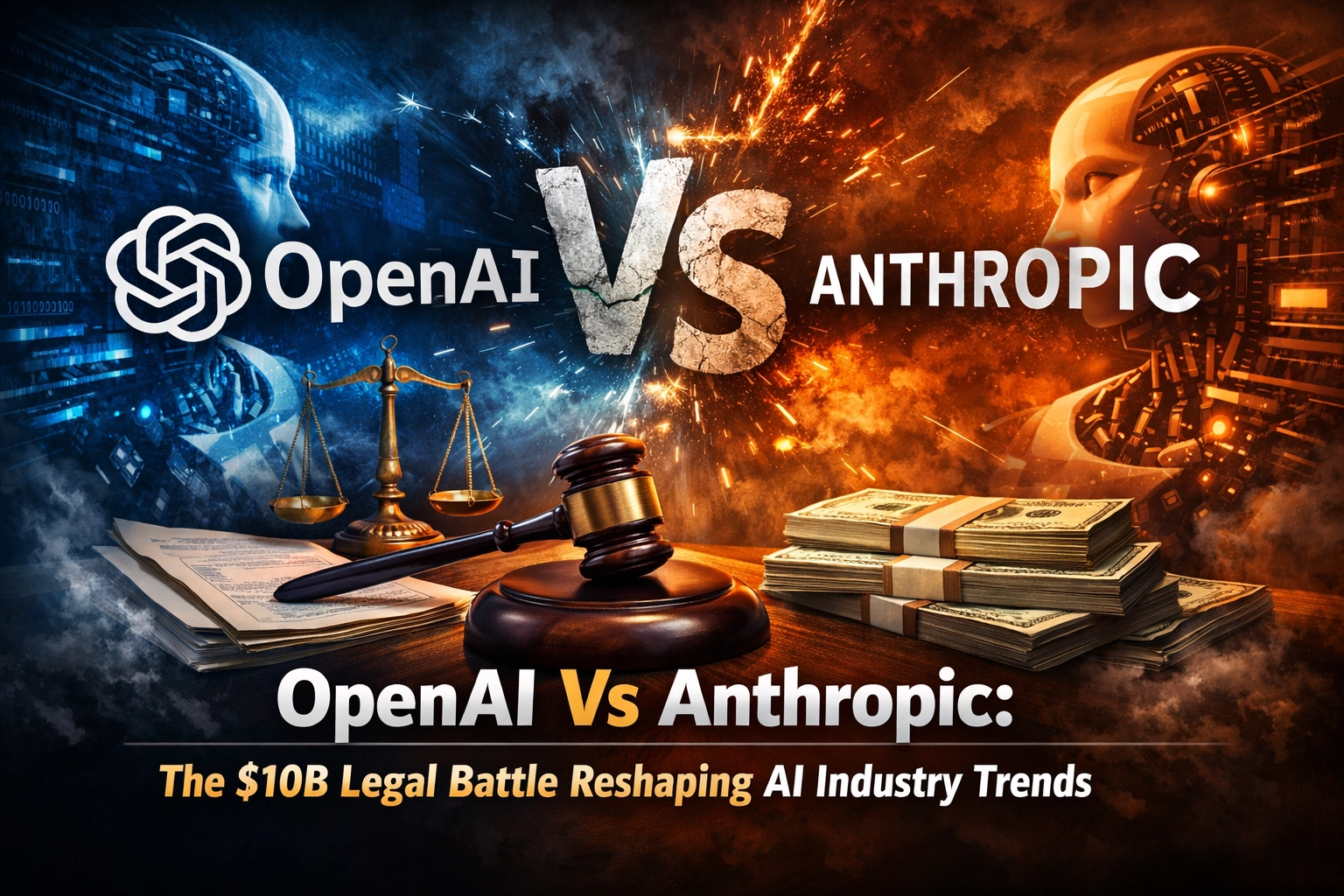

In a move that has sent shockwaves through Silicon Valley and the global technology sector, OpenAI has filed a landmark $10 billion lawsuit against its primary rival, Anthropic. Filed in the Northern District of California on the morning of March 20, 2026, the litigation alleges systemic trade secret misappropriation, breach of contract, and "industrial-scale poaching" of key engineering talent. This legal confrontation marks the most significant judicial battle in the history of artificial intelligence, threatening to redefine the boundaries of intellectual property (IP) and competitive conduct in the generative AI era.
The filing comes at a time when both companies are vying for dominance in the enterprise AI market, with valuations for both entities having ballooned over the past 24 months. The lawsuit centers on the development of Anthropic’s latest flagship model, Claude 4, which OpenAI claims was built using proprietary training methodologies and architectural secrets carried over by former OpenAI employees.
The Core of the Dispute: Architecture and Allegations
At the heart of the $10 billion claim is the allegation that Anthropic orchestrated a "coordinated campaign" to bypass non-disclosure agreements (NDAs) and non-compete clauses. OpenAI asserts that several high-level researchers, who departed the company in late 2024 and throughout 2025, transferred sensitive data regarding "next-generation reinforcement learning from human feedback" (RLHF) techniques and proprietary synthetic data generation protocols.
OpenAI’s legal counsel argues that the rapid advancement of Claude 4’s reasoning capabilities: which achieved parity with OpenAI’s latest models in record time: could not have occurred without the "unlawful utilization" of internal OpenAI research papers that were never intended for public release. The complaint specifically highlights:
- Proprietary Algorithmic Shifts: Allegations that Anthropic’s "Constitutional AI" framework now incorporates specific weighting mechanisms developed during OpenAI’s secretive "Project Strawberry" phase.
- Talent Migration: Since 2024, nearly 15% of Anthropic’s core technical staff are former OpenAI personnel. OpenAI claims this migration was not organic but incentivized by the promise of utilizing confidential knowledge to secure equity.
- Infrastructure Efficiency: Evidence presented in the filing suggests that Anthropic’s recent breakthroughs in compute-efficiency directly mirror internal benchmarks and optimization strategies developed for OpenAI’s custom "XPU" chips, currently being manufactured in partnership with Broadcom.

The $10 Billion Breakdown: More Than Just Damages
The unprecedented $10 billion figure is not a random valuation. According to industry analysts and the legal filing itself, the sum is a combination of direct economic damages, loss of market advantage, and punitive measures intended to deter future IP theft.
- R&D Investment Recovery: OpenAI claims it spent upwards of $4.5 billion on the specific R&D cycles it alleges were compromised.
- Market Capitalization Impact: The lawsuit argues that Anthropic’s "unfair competitive advantage" led to a valuation surge during its last $12 billion funding round, capital that OpenAI contends should have flowed toward its own ecosystem.
- Future Revenue Losses: Projections included in the filing suggest that the "theft" of specific reasoning capabilities will cost OpenAI billions in enterprise contract losses over the next five years.
This escalation mirrors the high-stakes legal battles seen in the early days of the smartphone era, specifically the Apple v. Samsung litigation, but with significantly higher stakes given the foundational nature of AI in the modern economy. The outcome could potentially freeze Anthropic’s ability to license Claude 4 to major corporate partners, creating a massive vacuum in the AI service provider market.
Significance: A New Era of AI Protectionism
The significance of this legal battle extends far beyond the two companies involved. It signals a shift from the "open science" ethos that characterized the early AI movement to a period of intense corporate protectionism. For business leaders and decision-makers, this litigation introduces a new layer of risk management.
Impact on Talent Acquisition
For years, the AI industry has operated on a "revolving door" policy where researchers moved freely between Google, Meta, OpenAI, and Anthropic. This lawsuit effectively ends that era. Companies are now likely to implement more stringent, iron-clad non-compete agreements and perform exhaustive "code cleaning" audits when hiring from rivals to avoid being named in secondary litigation.
Impact on Investment and Funding
Ventures and private equity firms may now view AI startups with more scrutiny. If foundational models can be tied up in litigation for years, the path to IPO or acquisition becomes significantly more complex. We are seeing a parallel to the California billionaire spending trends, where tech moguls are increasingly using their capital to influence both political outcomes and legal precedents to protect their technological moats.

The Global Regulatory and Trade Context
The OpenAI vs. Anthropic battle is not occurring in a vacuum. It coincides with heightened global scrutiny over AI dominance and technology transfers. As the U.S. continues to navigate complex trade relations, including the fresh investigations into U.S.-China trade truces, the protection of AI IP has become a matter of national security.
The U.S. government is reportedly monitoring the case closely. There are concerns that a prolonged legal battle between the two leading American AI firms could allow international competitors, particularly those in state-backed environments, to bridge the technological gap while the U.S. leaders are distracted by courtroom drama.
Furthermore, the legal precedent set here will likely influence how the U.S. handles global forced labor trade probes and other ethical audits. If Anthropic is found to have bypassed ethical "guardrails" in its pursuit of OpenAI's capabilities, it could trigger a wider regulatory crackdown on the entire sector.
What to Watch: The Next 90 Days
As the legal proceedings begin, the industry will be watching several key milestones that will determine the trajectory of the AI market for the remainder of 2026.
- Injunction Filings: OpenAI is expected to file for a preliminary injunction to halt the distribution of Claude 4’s API to new customers. If granted, this would be a catastrophic blow to Anthropic’s revenue stream.
- Anthropic’s Counter-Suit: Legal experts anticipate Anthropic will respond with a counter-suit, potentially alleging monopolistic behavior or "sham litigation" designed to stifle competition.
- Discovery Phase: The discovery phase will be particularly revealing, as it may force both companies to reveal more about their internal architectures than they have ever made public.
- The "Broadcom" Factor: With OpenAI moving toward custom silicon, any evidence that Anthropic attempted to gain insights into these hardware-software optimizations will be a critical focal point of the trial.
The AI industry has officially moved from the "build fast and break things" phase into the "litigate and protect" phase. For CEOs and stakeholders, the priority has shifted from purely monitoring model performance to evaluating the legal stability of their technology partners.

You may also like:
- U.S. to Release 172 Million Barrels from Strategic Reserve as Oil Prices Surge
- Trump Pressures Senate GOP Leader Over Save America Act
- Strait of Hormuz Crisis: U.S. Considers Naval Escorts for Oil Ships
What is your take on the OpenAI vs. Anthropic legal battle? Does this hinder innovation or protect the rights of creators? Let us know in the comments below.