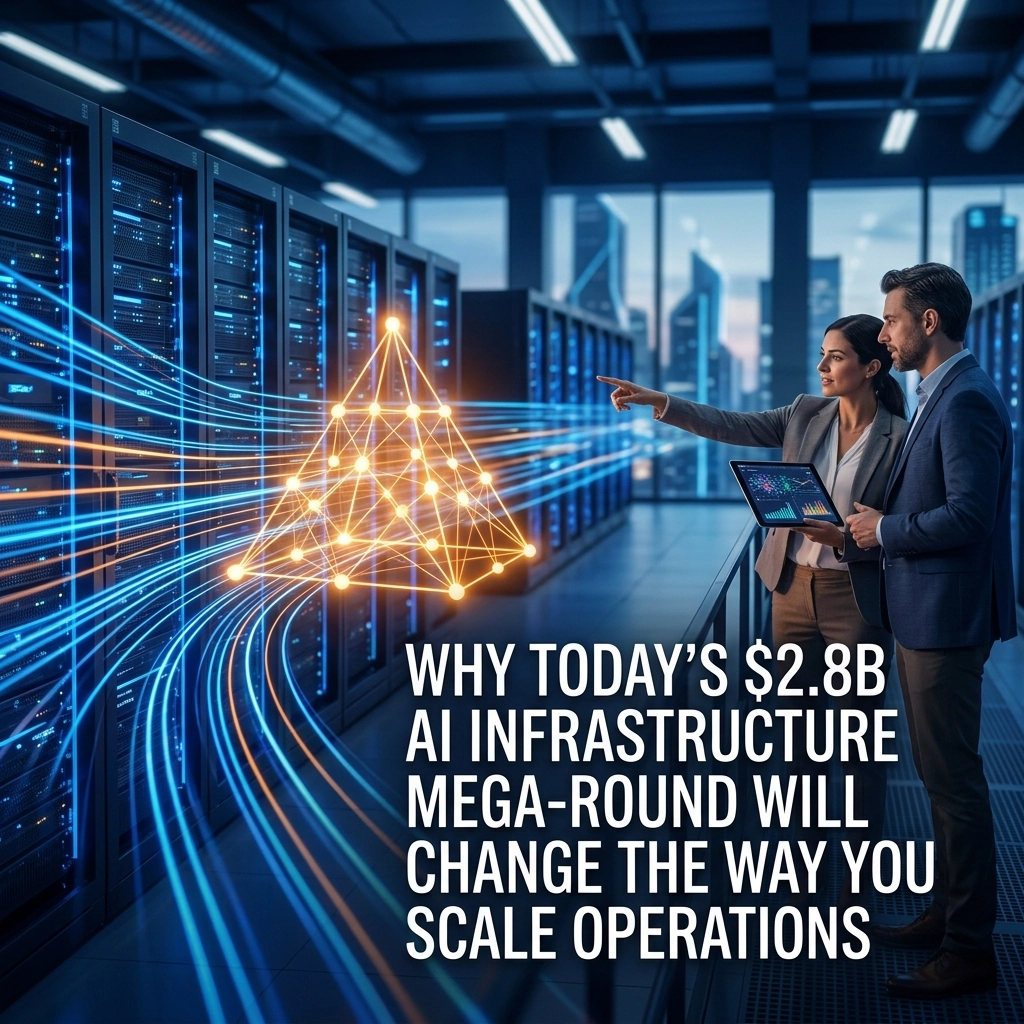
Why Today’s $2.8B AI Infrastructure Mega-Round Will Change the Way You Scale Operations

On Friday, April 3, 2026, the global artificial intelligence landscape reached a new inflection point. A $2.8 billion infrastructure mega-round was finalized this morning, signaling a profound shift in how capital is being deployed to support the next generation of enterprise scaling. This funding, led by a consortium of sovereign wealth funds and private equity giants, underscores a critical reality: the battle for AI supremacy has moved past software models and into the physical world of silicon, steel, and power.
As of Q2 2026, the industry is moving beyond the "experimental" phase of generative AI. Large-scale enterprises are no longer satisfied with API-based integrations; they are demanding dedicated, sovereign infrastructure. Today’s $2.8 billion injection is specifically earmarked for the development of modular, liquid-cooled data centers and proprietary hardware interconnects designed to bypass the traditional bottlenecks of public cloud providers.
The Pivot from Software to "Hard" Infrastructure
The significance of today’s announcement cannot be overstated. Throughout 2025, the market saw over $84 billion raised across various AI mega-rounds, but much of that capital was concentrated in foundation model development. As we move into the second quarter of 2026, the focus has shifted toward the "last mile" of AI deployment.
The $2.8 billion round finalized today focuses on three specific pillars of infrastructure:
- Direct-to-Chip Liquid Cooling: Reducing the massive energy overhead of current H200 and Blackwell-successor clusters.
- Edge Compute Nodes: Bringing low-latency inference to the manufacturing and logistics sectors.
- Sovereign Data Clusters: Providing enterprises with private environments that do not share backplanes with public internet traffic.
For decision-makers, this shift indicates that the cost of entry for truly competitive AI scaling is rising. To understand how this fits into the broader market, leaders should look at how today's 4.2B funding surge redefines your 2026 scaling strategy. The market is rewarding companies that control their own hardware destiny rather than those that lease it.

Why This Specific Round Matters for Enterprise Scaling
When a single entity or specialized consortium raises $2.8 billion for infrastructure in a single morning, it alters the availability of hardware for everyone else. In the current 2026 climate, hardware lead times have become the primary constraint on corporate growth. This mega-round effectively "locks in" production capacity at major foundries for the next 18 months.
For CEOs and COOs, the implications are immediate. Scaling operations no longer means simply hiring more engineers or increasing a SaaS subscription. It now requires a strategic roadmap that accounts for physical compute availability. Those who do not have a hardware-secured strategy may find themselves priced out of the market by late 2026.
The integration of these massive infrastructure capabilities will likely accelerate the enterprise AI integration shift, moving it from a localized IT concern to a core operational competency. If your organization is not planning for dedicated compute capacity, you are essentially at the mercy of the public cloud's spot pricing, which has seen 40% volatility in the first quarter of 2026 alone.
The Role of Geopolitical Stability in Infrastructure Investment
Today’s funding round does not exist in a vacuum. The massive influx of capital into Western AI infrastructure is partly a response to ongoing global volatility. Strategic investors are prioritizing domestic infrastructure to hedge against supply chain disruptions in the Middle East and East Asia.
Recent developments, such as the Trump administration’s gold deal with Venezuela and the shifting tensions in the Strait of Hormuz, have forced AI companies to reconsider their geographic dependencies. Data centers are power-hungry assets; energy security is now synonymous with AI security. The $2.8 billion raised today includes significant allocations for "off-grid" power solutions, including small modular reactors (SMRs) and direct-to-site renewables, ensuring that the infrastructure remains operational regardless of fossil fuel price spikes or geopolitical blockades.

Identifying the Next Move: ROI and Market Stability
Investors are searching for stability in an increasingly crowded market. While many have focused on the flashier aspects of AI, the "picks and shovels" of the industry: infrastructure: are providing the most consistent returns. For those looking at the financial metrics, looking for stable ROI in today’s AI infrastructure surge is the priority for Q2.
The $2.8 billion round reflects a valuation-to-funding ratio that is beginning to stabilize. Unlike the speculative bubbles of late 2024, the 2026 infrastructure rounds are backed by long-term enterprise contracts. Companies like Cerebras and Crusoe have already set a precedent, with Cerebras achieving an 8.2x valuation-to-funding ratio earlier this year. Today’s round suggests that the market is willing to pay a premium for hardware that is already on the ground and operational.
What to Watch: The Next 90 Days
As this $2.8 billion is deployed, several key developments will likely emerge before the end of the quarter:
- Hardware Consolidation: Smaller infrastructure startups may be absorbed by this newly capitalized giant to consolidate chip allocations.
- Energy-First Site Selection: Expect announcements regarding new data center builds in regions with redundant, non-grid-dependent power sources.
- Supply Chain Prioritization: A potential "hardware squeeze" for mid-market firms as the top-tier players corner the market on advanced GPU and NPU (Neural Processing Unit) shipments.
Decision-makers should also keep an eye on how these developments interact with broader economic trends. For instance, markets in turmoil and investor unpredictability can lead to sudden shifts in interest rates that might impact the cost of the remaining 2026 infrastructure debt.

Conclusion: Preparing Your 2026 Strategy
The $2.8 billion mega-round is a signal that the infrastructure "land grab" is entering its most aggressive phase. For companies looking to scale operations, the window to secure dedicated compute and infrastructure at current prices is closing. The transition from general-purpose cloud computing to specialized AI infrastructure is no longer a "future" trend: it is the present reality.
Business leaders must evaluate their current scaling strategies against this new capital concentration. If you are not building an infrastructure-first roadmap, you are likely planning for a world that no longer exists.
You may also like:
- How today’s 1.5B AI funding surge affects every CEO
- The 10 things you should know about the massive Series E AI funding surge
- Why everyone is talking about this morning’s 3B AI infrastructure funding
How is your organization addressing the current compute shortage? Are you looking toward dedicated infrastructure or sticking with public cloud solutions? Share your thoughts in the comments below.