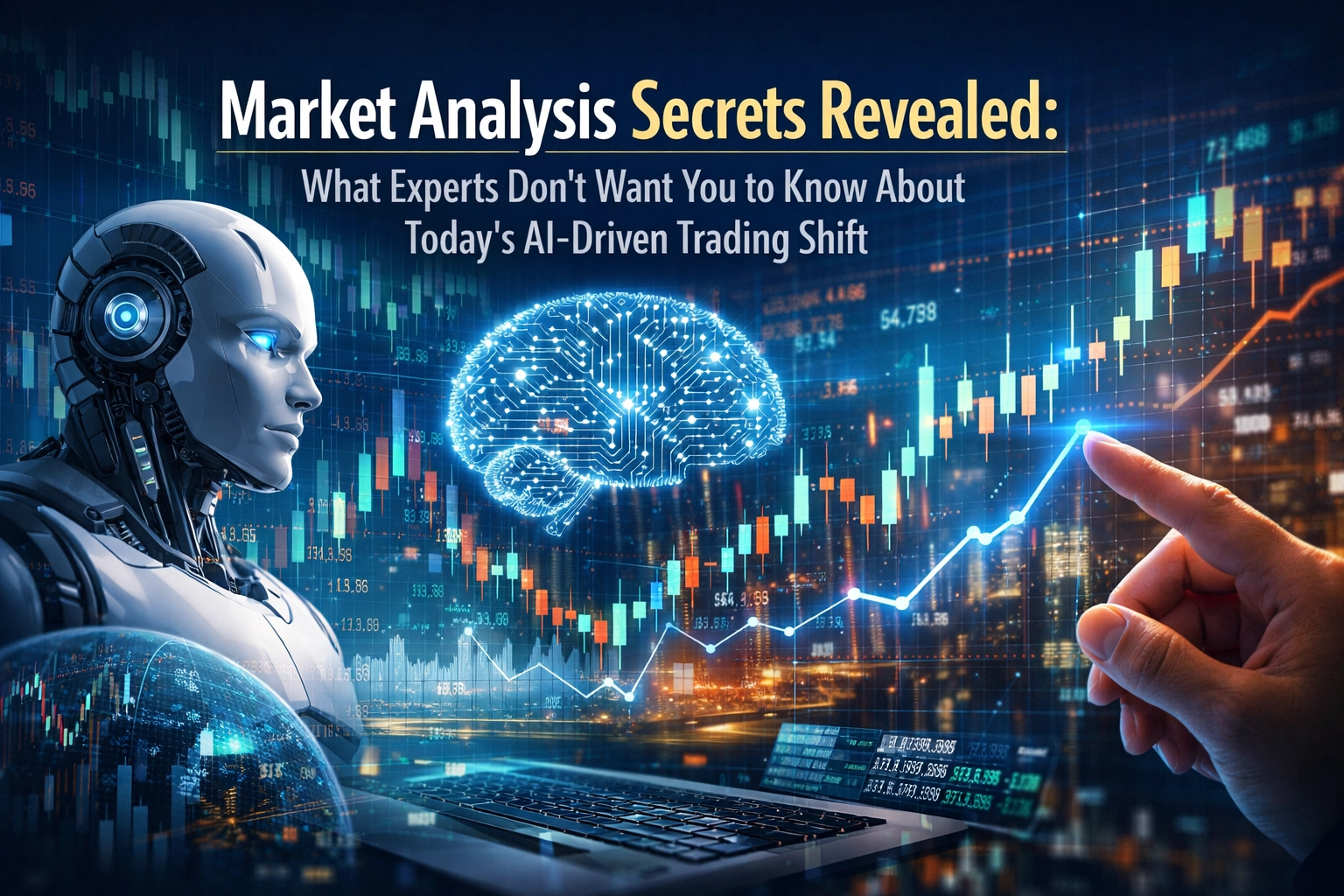
Market Analysis Secrets Revealed: What Experts Don’t Want You to Know About Today’s AI-Driven Trading Shift

As of mid-March 2026, the global financial markets are operating under a paradigm shift that has effectively rewritten the rules of technical and fundamental analysis. The surge in generative AI and autonomous trading systems has created a market environment where traditional indicators often fail to predict volatility. While retail sentiment remains focused on the "AI boom," institutional insiders are increasingly concerned about a structural fragility hidden beneath the surface of record-breaking indices.
The primary driver of this shift is a combination of extreme capital concentration and a looming physical constraint that many analysts are overlooking: the energy required to sustain the digital revolution. Today’s analysis reveals that while AI is the primary engine of growth, it is also the greatest source of systemic risk in the current fiscal year.
The 90% Reality: AI as the Sole Engine of Growth
Recent data from the first half of 2025 and early 2026 indicates that artificial intelligence investment has become the nearly exclusive driver of U.S. economic expansion. Reports suggest that AI-related capital expenditures accounted for more than 90% of U.S. GDP gains during the previous fiscal year. This unprecedented reliance on a single technological vertical has created a "monoculture" in the equity markets.
Experts and institutional desks are quietly acknowledging that the broader economy: outside of the tech and semiconductor sectors: is experiencing a period of stagnation. This creates a deceptive market environment where the S&P 500 and Nasdaq-100 reach new highs, while the average constituent company struggles with high interest rates and declining consumer demand. For decision-makers, the secret is recognizing that we are not in a "broad bull market," but rather a "vertical AI hyper-cycle."
Concentration Risk: The Fragility of the S&P 500
The most significant overlooked risk in 2026 is the extreme concentration of wealth within a handful of technology giants. Nearly 50% of the S&P 500’s total market capitalization is now derived from AI-linked firms. This level of concentration is historically unprecedented, surpassing the peaks seen during the 1999 dot-com bubble or the 1970s "Nifty Fifty" era.
This dependency means that any single negative catalyst within the AI supply chain: such as a breakthrough in regulatory antitrust action or a hardware manufacturing delay: can trigger a systemic market correction. Professional traders are no longer just watching interest rate hikes from the Federal Reserve; they are monitoring the quarterly compute-allocation reports of three or four key players. If investor assumptions about long-term AI profitability prove even slightly incorrect, the market faces a "de-leveraging event" that could wipe out trillions in paper wealth within hours.

The Energy Bottleneck: The Hidden Gatekeeper
While the financial world focuses on algorithms and software, the physical reality of the power grid has emerged as the true limit to AI expansion. Data center electricity demand is projected to more than double by the end of 2027. This has transformed energy infrastructure into a critical market variable.
Grid constraints are not just an operational hurdle; they are an inflationary risk. As tech giants compete for limited power resources, energy prices for commercial and residential sectors are being pushed higher, leading to localized economic friction. This is compounded by broader energy market volatility. For instance, the recent U.S. move to release 172 million barrels from the strategic reserve highlights the sensitivity of the administration to energy costs as oil prices surge amidst geopolitical instability.
For the AI-driven trading shift, the "secret" is that the next phase of the bull market will be won not by the companies with the best code, but by those with the most secure access to high-density power and cooling infrastructure.
Valuation Disconnect: Theoretical Returns vs. Concrete Cash Flow
A growing chasm has opened between current earnings and future expectations. Rising price-to-earnings (P/E) ratios across the technology sector indicate that investor optimism is increasingly tied to theoretical "AGI dividends" (Artificial General Intelligence) rather than realized revenue.
The market is currently rewarding AI adopters that show real monetization: those with cash-flow margin expansion outpacing the global average by double. However, the market is simultaneously punishing uncertainty with extreme prejudice. Software-as-a-Service (SaaS) stocks that have failed to integrate "agentic" AI features have seen significant drawdowns, reaching what analysts call "peak uncertainty."
Strategic investors are moving away from speculative "AI-wrapper" companies and toward firms that control the "physical layer": the chips, the energy, and the specialized data.

Geopolitical Friction and Supply Chain Vulnerabilities
The AI-driven trading shift is inextricably linked to global trade tensions. The hardware required for the AI revolution remains a primary focal point of international conflict. The ongoing U.S.-China trade truce is being tested as Washington launches fresh investigations into technology transfers and semiconductor manufacturing equipment.
Furthermore, the global forced labor trade probes are creating new tariff risks for hardware components sourced from across Asia. For the market analyst, these are not just political headlines; they are direct inputs into the cost-of-goods-sold for the companies driving the S&P 500. A disruption in the South China Sea or a new set of tariffs can render current AI growth projections obsolete overnight.
Significance: Why This Matters for Business Leaders
The shift toward AI-driven trading and market concentration has three major implications for business leaders:
- Reduced Diversification Efficacy: Traditional 60/40 portfolios are less effective when a few tech stocks dictate the movement of both equities and, indirectly, the bond market’s inflation expectations.
- Increased Volatility Peaks: Automated trading systems execute at speeds that can create "flash crashes" in specific sectors, requiring more robust risk-management protocols for corporate treasuries.
- The Shift to Infrastructure: Real value is migrating from the software layer to the physical layer. Business strategy must now account for energy availability and hardware sovereignity.
What to Watch Next: The Road Ahead in 2026
As we move deeper into 2026, several key indicators will determine whether this AI-driven shift remains a sustainable growth engine or becomes a historical bubble:
- Monetization Deadlines: Watch for the Q3 2026 earnings reports. If major enterprises do not show significant productivity gains or cost savings from their AI investments, a massive re-valuation of the sector is likely.
- Energy Policy and Grid Investment: Any federal or state-level legislation that fast-tracks nuclear or modular energy projects will be a "buy" signal for AI infrastructure.
- Geopolitical Bottlenecks: Monitor the Strait of Hormuz crisis and its impact on global energy costs. If oil and gas prices remain elevated, the margins for energy-hungry data centers will shrink, dragging down the tech giants.
- Regulatory Shifts: Keep a close eye on the wealth tax votes and political spending in tech hubs like California, which could signal a change in the capital gains environment for the billionaire class driving these investments.
The secret to navigating today's market is understanding that the "AI shift" is no longer a future prediction: it is a current, high-stakes reality that has concentrated global risk into a single, power-hungry vertical.
You may also like:
- The impact of wealth tax votes on California’s billionaire class
- U.S. Navy and the Strait of Hormuz oil shipping crisis
- New investigations into U.S.-China trade relations
What is your take on the AI-driven market shift? Is the energy bottleneck the real threat, or is concentration risk more concerning? Let us know in the comments below.